Lamingtons

If you have never been to Australia, you have probably never had a lamington. If you are an Australian (or are from New Zealand), you have probably had quite a lot of them.
Lamingtons are an Australian snack cake consisting of squares of sponge cake dipped in a chocolate icing and rolled in desiccated coconut. Sometimes they have a layer of jam in the middle of the sponge. They were originally created as a way to use up leftover or stale sponge cake, because the chocolate coating will add and lock in moisture. The coconut is added because coconut is great. You could, I suppose, use chocolate sprinkles if you really cannot abide coconut. I would not try and pass this off as a lamington, though.
The chocolate layer is not melted chocolate, but a mixture of milk, cocoa powder and confectioners sugar with a tiny bit of butter added for flavor. This glaze is easy to handle and firms up quickly. It is not greasy and makes the whole snack very easy to handle and transport.
Judging from some of the greasy, dry lamingtons I’ve had, it is clear that some bakers have taken the “stale cake” idea to extremes. This is particularly apparent because lamingtons seem to be getting larger and it is significantly more difficult to choke down multiple mouthfuls of overly dry cake. They also seem to have enbraced the belief that using real chocolate, regardless of how much oil or shortening it is mixed with, is superior to the traditional icing, rendering the entire lamington greasy and difficult to handle.

(more…)

Classic White Cake with Buttercream Frosting

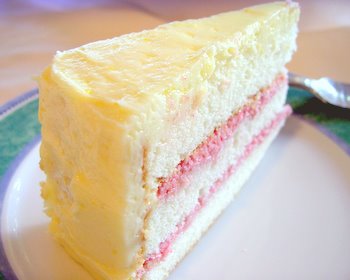
piece of cake

White cakes are very much underrated. It’s often hard to find them and many people seem to be under the impression that they will unfailingly be dry and not worth eating. I, on the other hand, love them. Which is why I was so pleased with class today, where we made a beautiful, layered, wedding-style white cake.

Most great cake bakers will have one great recipe for chocolate cake and one great recipe for white cake. Instead of continually modifying the flavoring of the cakes themselves, which could adversely affect the texture, they will create many different syrups, mousses and frostings to add flavor to their cakes. Sponge cakes and genoises, which are not typically used for wedding cakes, will often be dipped in or generously brushed with syrup, both for moisture and for flavor. They will often be filled with a flavored mousse or whipped cream, as these cakes can be stored in the refrigerator because they do not have any (or have very little) fat in them that will solidify at a low temperature. Butter cakes inherently have more flavor than sponge cakes due unsurprisingly to the presence of butter. Because of the added fat, butter cakes are more moist than sponge cakes and will not need syrups for flavor and moisture. They will typically be paired with things like fruit and frostings. If you are layering a butter cake, as we did today, you will probably want to brush it with a simple syrup - a 1 to 1 ratio of sugar and water - as a crumb coat. The syrup can be infused with a flavor, which will have a subtle presence in the finished cake.

We made white cakes and buttercream frosting today. Despite the name, there is no cream in a buttercream. I’ve never made a true buttercream before, where boiling sugar is added to whipped egg whites, beaten until fluffy and then beaten with butter until smooth. It wasn’t terribly difficult, but it had to be beaten in the electric mixer for over 20 minutes, so it was quite noisy. The basic recipe makes a frosting that is not too sweet and very buttery.

(more…)

Perfect Ciabatta

This loaf is one of the finest I’ve produced in recent memory. The interior was moist and chewy and the exterior was wonderfully crisp. It tasted so perfect. I think the reason that the texture turned out so well is probably the fact that it received only the barest minimum of kneading during its rises, hence there was very little risk that I would over- or under-knead it.

I used the recipe for the Very Lightest Ciabatta from King Arthur Flour but I made a few changes. The two minor changes were using active dry yeast instead of instant yeast and reducing the amount of olive oil to an amount that I would describe as a “splash”. It was probably one to two teaspoons.

(more…)

Homemade Whole Wheat Crackers

Due to my recent cracker making success, I decided to try my hand at making savory crackers. After much searching, and realising that there are not a lot of simple cracker recipes to be had, I came across this one by Mark Bittman. How can a man who wrote a book titled How to Cook Everything be wrong? Of course, I didn’t want some boring, plain flour crackers, so I made a few modifications.
These were simple to throw together, and had a good feel and texture. They weren’t quite as nice and flakey as store bought crackers, but that is probably because my butter wasn’t really chilled. They tasted good, though. The only real problem was that not all of my crackers were crisp all the way through. Most of them were cut in roughly one inch squares, but the slightly larger ones seemed to retain some softness in the center. Even the large ones firmed up as they cooled, but I think that I will be more careful about cutting them equally in the future.
I’ll definately make this recipe again. I like the seasonings I used (I have used them to make crackers in the past), but I think they would do very well with variations, like sesame seeds, black pepper, even brushed with vinegar and salt.

(more…)

Orange Julius

How lovely for Foodgoat to announce this month’s Is-My-Blog-Burning theme as orange. I, rather appropriately, chose to use both the color and the fruit in my entry.
I also chose to relive a childhood treat by making an Orange Julius at home.
An Orange Julius is a cold, frothy orange drink. It is thinner than a smoothy, but thicker and creamier than plain orange juice. It was invented in 1926 in California at an orange juice stand and, over the next 80 years, spread to malls across America. The secret to the original recipe was the addition of egg white, which made the drink very frothy. Nowadays, what with salmonella and all, Orange Julius is made with a secret, dairy-derrivative that makes it foamy. I’m guessing that it is some sort of powdered creamer.
The recipe I used is based on the original formula. It called for pasturised egg whites/egg substitute, but I chose to tempt fate and use an ordinary egg white. The results were wonderful, and I’m not saying that simply because I suffered no ill effects. Quite the contrary. I juiced some fresh oranges and the drink turned out to be frothy, creamy and very refreshing. It was also quite addictive. I would bump up the amount of ice next time to make it a bit slushier, but the taste was fabulous and just how I remembered it.
The recipe is from Top Secret Recipes. I believe that it is in one of his books, but it is also posted here on his website. I won’t reprint it here, but I recommend it!
Thanks to Foodgoat and Ladygoat for picking a great theme for this month’s event and finally motivating me to try this recipe!

Homemade Graham Crackers

When Derrick announced the theme for this month’s Sugar High Friday as molasses, I was stumped. What do you go with molasses? The things that immediately jumped to mind were ginger crinkles, ginger snaps and gingerbread - none of which fit terribly well with springtime snacking. Cakes and pies and puddings… molasses just seems to make everything heavy. Then I realised that molasses doesn’t have to make things heavy. It is just often used as a sweetener in heavier things.
So what is something nice and light? Hmm… how about marshmallows. And what goes with marshmallows? Graham crackers and chocolate to make s’mores.
Now we were talking.

I’ve been wanting to try homemade graham crackers for some time now. I even went out and bought a cookbook, Retro Desserts by Wayne Harley Brachman, that I knew would have a recipe for it. Grahams use both honey and molasses, so the flavor of molasses isn’t overwhelming. The cookies turned out to be amazingly crumbly and delicious. I didn’t have 1/2 cup of graham or rye flour, as the recipe called for, so I just substituted whole wheat flour. This led the final product to have a texture strikingly similar to store-bought grahams, meaning that they were flakey and not dense. In fact, I was thrilled since a similar texture means that probably I made them correctly!

I whipped them up in the food processor in no time. The dough was incredibly easy to roll out and I’m sure it could be rerolled once to use up any scraps, though I just ate some raw and tossed the excess. The only change I would make to the recipe is to roll the crackers out thinner than the 1/4 inch called for. I aimed for 1/8 inch and they puffed up a tiny bit in the oven.

I would not hesitate to use this instead of graham cracker crumbs the next time I was in need of a pie crust, either.

(more…)