Archive for the ‘New Products’ Category

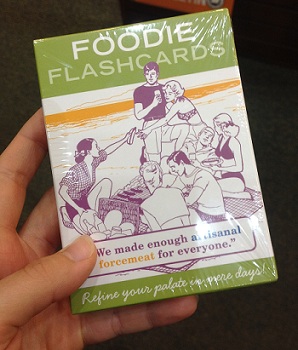
The last time you probably used flash cards was when studying for a vocabulary test of some kind in school. They’re usually set up with a word on one side of the card and a definition on the other, giving you an easy way to quiz yourself with a deck. They will work for just about any subject, and these Foodie Flashcards are designed to give you a crash course in foodie terminology. The deck contains 50 cards featuring different foodie vocabulary words. Each card features a word on one side, and the definition, pronunciation and examples of how it is used on the back. They’re humorous cards, so while they really will clear up some terms you might not have been familiar with, they’ll definitely do it in a way that will put a smile on your face, too.
You really will be able to improve your foodie vocabulary and get a clearer idea of what terms like “locavore” and “umami” mean, but even if you’re familiar with the terms, you’ll enjoy the way that they’re presented. The cards also include a foodie game insert, which gives you ideas for things to do while waiting at the food truck for your fusion taco order to come up. This is a fun gift for a foodie friend, but the cards can also be fun to go through if you’re with a bunch of other food-loving friends and want to quiz each other a little bit.

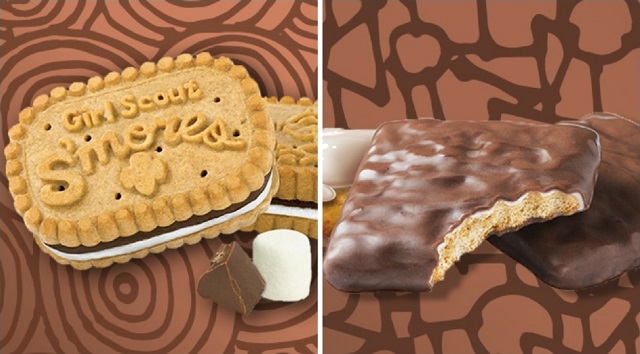
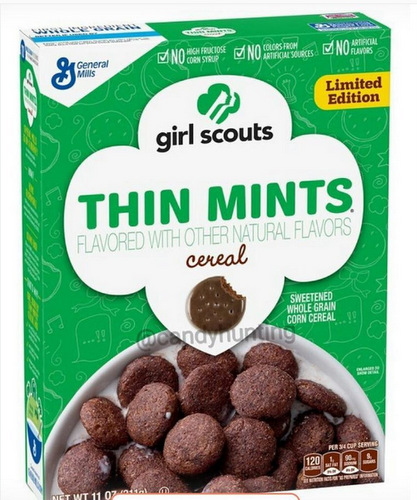
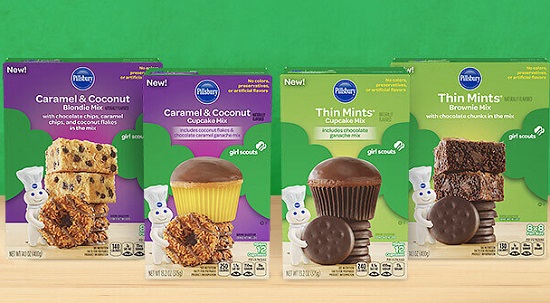
Girl Scout cookies are a treat that usually only comes into season once a year, when Girl Scouts hit the streets (or markets or churches) for their annual cookie sales. The popular Girl Scout cookie flavors can also be found in a few other forms, including Dreyer’s/Edy’s limited edition ice cream flavors and now in candy bars. The Girl Scouts have recently paired up with Nestle to launch three Girl Scout cookie-inspired candy bars. The candy bars are crossovers with Thin Mints, Caramel & Coconut (Samoas) and Peanut Butter Creme (Tagalongs), sandwiching the cookie filling with layers of thin, crispy wafers and enrobing them in chocolate. I think that they picked good flavors for the candy bar crossovers, not only because these are the most popular flavors, but because they are the most distinctive. You’re much more likely to associate the flavors in the bars with the cookies. And since I don’t think that there are enough coconut and caramel candy bars on the market, I’m definitely up for tasting the Samoas bar when I see one.
If you happen to be a fan of Nestle Crunch on Facebook (you’ve already “liked” Baking Bites on Facebook, right?) , you can actually order these candy bars their their special presale. Otherwise, you’ll have to wait until later this summer to get your hands on them. They’re set to roll out to stores nationwide starting in June. And, if candy bars aren’t your thing, you can always get your Girl Scout cookie fix by baking up a batch of my homemade Girl Scout Cookie recipes in your favorite flavor.

Nonstick parchment paper is a great tool to have in the kitchen. Perfect for lining cookie sheets and cake pans, parchment paper makes cleanup easy and prevents your baked goods from sticking to your pans. Parchment paper is best used on flat surfaces (such as the bottom of pans), but there are things that I bake that I like to be able to lift out of the pan for cooling, slicing and serving. These include coffee cakes, brownies and bar cookies, and when making these types of baked goods, I typically line my pans with aluminum foil and lightly grease it. I can lift the foil right out of the pan (I wrap it up, over the sides) and my baked goods don’t stick.
Reynolds Wrap has managed to combine aluminum foil and parchment paper into one product, their new Nonstick Pan Lining Paper. This paper has foil on one side and parchment on the other. The idea is that the foil allows the paper to conform to the shape of the pan – sides and all – but the parchment paper gives it a nonstick finish with no extra greasing required. This product is a little more expensive than both foil and parchment are, but I picked up a roll recently to see how it performed.
The paper feels heavy, much thicker than either plain aluminum foil or parchment paper. It pressed easily into my pans (sheet pans with shallow sides and deeper, rectangular baking dishes), wrapping into the corners and up the sides easily and staying exactly where I contoured it to my pan, although I noticed that it didn’t have quite as much flexibility as plain aluminum foil. The parchment side of the paper worked just like regular parchment, so it definitely didn’t need to be greased. Overall, I was happy with the performance, but lightly greased aluminum foil works just as well for most baking applications. I would choose this for more heavy duty baking (like lasagna, which Reynolds Wrap actually recommends) where I would think that foil alone might not hold up to the job.
Update: My paper did curl around the edges when I used it on baking sheets without “wrapping” the edges around the sides of the pan, however this didn’t seem to impact what I was baking in any way, as the thick paper stayed flat under my baked goods.

You might want to use a little extra caution the next time you pop a pyrex baking dish into the oven because Consumer Reports has noticed an uptick in the number of incidents involving exploding or unexpectedly shattering glass bakeware that have been reported recently. Not all of these incidents result in injury, but even if you don’t end up with a burn or a cut from a hot piece of glass, you could very well end up with an oven full of shards.
Pyrex and other glass bakeware is traditionally made of borosilicate, a type heat resistant glass that is fantastic for baking because it can easily withstand the high temperatures of the oven without breaking or cracking. This type of bakeware is even strong enough to hold up to sudden, sharp temperature changes. So why are some of them shattering unexpectedly when put into the oven or another high heat environment?
At some point, makers of glass bakeware, especially in the United States, switched from using borosilicate to using soda lime glass, which is less expensive to produce. Pyrex manufacturers in Europe still use borosilicate and any glass pans that you inherited from your parents or grandparents are made of borosilicate. Soda lime glass can more impact-resistant than borosilicate is, but it is not as resistant to heat or abrupt temperature changes as borosilicate is. Manufacturers World Kitchen and Anchor Hocking state that they put their soda lime glass through a thorough thermal tempering process to maximize its strength, but most of the reported incidents are from their products (not that surprising, since they produce about 75% of the glass bakeware in the US) and many of the incidents involved spontaneous breakage, rather than misuse or exposure to unusual conditions.
Consumer Reports put together a great video that shows the difference between borosilicate and soda lime glass. Glass bakeware is still safe to use, but if you have older pieces they are probably stronger and much less likely to shatter under normal use conditions.

The standard chocolate chip for a chocolate chip cookie is semisweet chocolate, but over the past few years chocolate chip cookie-lovers have been looking for ways to improve on their favorite by chopping up other types of chocolate and adding them to their cookies. You can grab just about any kind of chocolate bar you like, with any cacao percentage, chop it up and add it to a batch of cookies to customize them to your personal tastes. I think that there is still something to be said for having that classic chocolate chip shape in my chocolate chip cookies, though, so I am always willing to try a new chocolate chip flavor if I spot one. Lately, I’ve been seeing new Nestle Tollhouse Dark Chocolate Morsels on store shelves and picked up a bag to try.
This dark chocolate version of the classic Tollhouse chip boasts a 53% cacao content and that it is a natural source of antioxidants on the front of the package, and it is a little bit more affordable than some of the premium dark chocolate chip brands out there. The chocolate chips do have a distinct dark chocolate flavor, with a distinct cocoa flavor and some fruity notes to back it up. Unlike a bar of dark chocolate, where you want the chocolate to have a sharp snap to it, these have a very smooth texture and melt easily in your mouth. This makes for a great melt in a still-warm chocolate chip cookie and actually produces a much more satisfying result than many other dark chocolates would. I’ll keep darker chocolate bars for snacking, but these dark chocolate chips are definitely a great choice for getting some dark chocolate into your baking.