Low Fat Fudgy Brownies

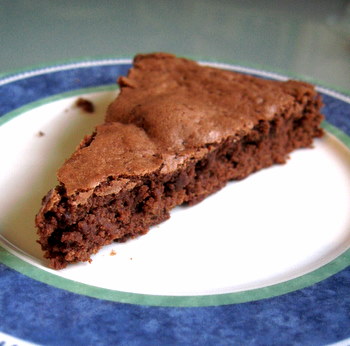
Low Fat Fudgy Brownie Wedge

I happened to catch an episode of the America’s Test Kitchen TV show this past weekend and was suprised - and delighted - to see that it was about making low-fat versions of two chocolate favorites: brownies and chocolate mousse. Naturally, I quickly scrounged around for a pen and something to write on (I ended up with a napkin - which, incidentally, I do not recommend for general recipe writing because it’s too easy to accidentally thrown them away while you’re working in the kitchen) before they read out the recipes so that I could give them a try.

I decided to make the brownies first. The goal for the test kitchen crew was to come up with a low fat brownie recipe that (a) tasted as good as full-fat brownies, (b) didn’t need a tiny portion size to qualify as low in fat and (c) didn’t have any unusual, non-brownie ingredients in them. As a result, these brownies don’t use any applesauce, prune butter, etc., even though they only have 2 tablespoons of butter! The trick, it turns out, is to play up the chocolate flavor of the brownies as much as possible without focusing only on the added fat. The brownies use both cocoa powder and some melted chocolate for richness.

I ended up making a couple of adjustments to the recipe anyway, but the brownies were great. They did taste like “regular” brownies and had a very strong, rich chocolate flavor. They had a chewy/fudgy texture and, although they still felt less dense than a traditional fudgy brownie, they were super satisfying. They definitely did not taste low fat and I would say that they had a much better texture than most of the “low fat” brownies that I’ve tried because they were not cakey or gummy.
delicious, with a lovely chew and a fudgy feel. don’t taste low fat or light at all. excellent dakr chocolate flavor.

The two big changes I made were using a round cake pan to make a slightly thicker brownie than the original recipe would have made and leaving out the “secret ingredient.” The ATK secret ingredient for this recipe is Hershey’s chocolate syrup. Adding only a tablespoon or two of it to the batter will, supposedly, enhance the chocolate flavor of the brownies and help give them a shiny top. Mine didn’t have a shiny top, but I don’t think that I really missed out on much by not adding the syrup, especially since it is corn syrup based.

(more…)

Easy Pb&J Jar

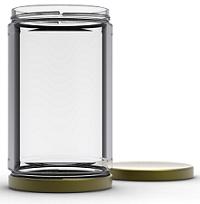
Easy Pb&J JarAlthough it’s called the Easy Pb&J Jar, this innovative jar is good for more than just peanut butter and jelly storage. The jar has screw-tops on either end and perfectly straight sides. This completely eliminated the rounded edges usually found at the bottom of “regular” jars and the rim found underneath the top opening, where the jar comes up and narrows, and prevents you from struggling to get the last bits of peanut butter or other spreads out with a knife. It was designed by Sherwood Forlee, who has also done design engineering work for companies like OXO.

Unfortunately, no design is perfect. The problem here, of course, is that you’re either going to have to transfer your peanut butter and jelly from their old, inconvenient jars to this new one (possibly losing some in the transferal procedure) or make your own to fill the jar. Until jars like these catch on and companies start packaging in something similar, I’d opt for a mini spatula to help you get the last out of your current jars and save these new ones - when and if they’re available - for when you make a batch of homemade nut butter or jam and need to store it.

[via Neatorama]

Pluots, apriums and Floyd Zaiger

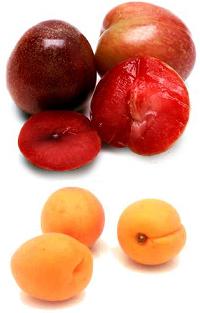
Pluots and apriumsIf you want to find the best fruits you can, your best bet is to find out what is in season and seek it out from a high-quality vendor at a good local farmer’s market, where the produce will be the freshest. If you want to find the perfect fruit, however, your best bet is to become a biologist who specializes in fruit genetics. Biologist Floyd Zaiger has pretty much dedicated his career to the development of the perfect fruit and, as a result of his work, we’re seeing all kinds of interesting fruit hybrids gaining popularity.

The most well-know is the pluot, since it is currently the most widely available new hybrid. It’s a cross between a plum and an apricot, roughly 75% plum and 25% apricot. They resemble plums in appearance, with smooth red skin that is sometimes mottled with a lighter yellow-red color, and taste quite a bit sweeter than your average plum, although they are fairly similar in flavor. There are several varieties of pluot, so color and shape can vary a bit. The fruits are also slightly hardier than pure plums are, so they ship and store better than the non-hybrids. They are in season from about May through September.

Apriots are also plum-apricot hybrids, but they have the opposite ratio of pluots: roughly 25% plum and 75% apricot. They look very like apricots and have a fuzzy, pink-hued yellow skin, although they are slightly larger than apricots are. They are very sweet, with an unusualy high sugar content even for ripe stone fruit. Their season is very short and usually only lasts through the month of June, give or take a few weeks.

Other hybrid fruits that Zaiger, though his company Zaiger’s Genetics, has developed include: peacotums (peach-apricot-plum), plumcots (another plum-apricot) and nectaplums (nectarine-plum) and nectarcots (nectarine-apricot), as well as a wide variety of other hybrids involving stone fruits.

Do I need an angel food cake pan?

angel food slice

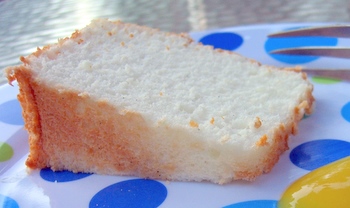
Angel food cakes are a bit unique in that they always come in the same size and shape. Recipes call for a specific pan and, while it’s possible to make smaller versions of angel food cakes in loaf pans or cupcake pans, a 9- or 10-inch tube pan with a removable bottom is standard. Lots of people who have never made an angel food cake at home ask if it is required to make a good angel food cake.

The answer is yes. Angel food cakes are foam cakes and, although there is some flour in the batter to add softness and help hold the cake together, they get most of their body from beaten egg whites. Air pockets in the egg whites expand as the cake heats up in the oven, lifting the cake. The pan is designed to ensure that the cake bakes evenly and rises as high as possible. The tube design - with the hollow core at the center of the cake - lets heat evenly reach the entire cake, so that the outside edge is not done long before the cake’s center. This is especially important with an angel food cake (although pans like the Baker’s Edge use a similar principle) because the cake is very delicate during baking and it needs all the help it can get to rise up. The other factors that helps the cake rise are the material and shape of the pan. The sides of the pan must be straight and should not be made of a nonstick material. This ensures that the cake can “grip” the pan and “pull” itself up. Since the delicate cake must be cooled upside down to prevent it from collapsing, a non-nonstick surface will also ensure that the cake remains firmly in the pan during this time.

Coconut Angel Food Cake

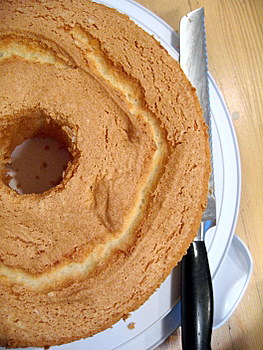
Coconut Angel Food Cake

When I make angel food cake, I usually opt to make a plain cake rather than a flavored one. The standard flavoring for an angel food cake is vanilla, sometimes spiked with a little bit of almond (this is also how a classic white cake is flavored) and it’s a combination I really enjoy. The plain cake is flavorful, moist and tasty both on its own and when paired with fruits, sauces, etc.

But because it is a relatively plain cake, it is easy to come up with flavor variations for it. A little variety is a good thing and so I’ll occasionally make a flavored angel food cake. The easiest ways to change up the flavors are by adding citrus zest or by substituting the vanilla extract in the basic cake for another flavor. This particular cake is a coconut angel food cake and I opted to use fresh, shredded coconut for flavoring instead.

Even though I started with shredded coconut, I pulsed it in my food processor before I began to construct the cake to ensure that it was very, very finely chopped. Angel food cakes should be delicate, with a fine and even texture. I didn’t want strands of coconut interrupting that or - even worse - adversely affecting the rise of the cake in some way. The cake’s lightness comes from beaten egg whites, as well as from the use of low protein cake flour and superfine sugar. The cake flour keeps everything tender and the superfine sugar, since it dissolves more quickly than regular sugar, ensures the cake will not be grainy.

(more…)

Bites from other Blogs

  • When I make an ice cream cake, it’s usually for a party or a barbecue and, since there are a lot of people to serve, I usually opt to make a full-size sheet cake, like my Mint Chocolate Chip Ice Cream Cake. There’s no reason that ice cream cake can’t be turned into ice cream cupcakes, however, and Joy the Baker used my two favorite ice cream cake flavors to make a batch of ice cream cake cupcakes. Start any regular cupcake recipe and only fill the cups half-full. Top cooled cakes with ice cream, freeze and you’re good to go.
  • I absolutely love ripe mango, whether it is in a simple fruit salad or used in a more elegant dish. Fresh from the Oven’s Mango Mascarpone Mousse Cake is on the latter end of the spectrum. The beautiful cake is made with a foolproof sponge cake that then layered with sweet mango mousse. The “mirror” on top of the dessert makes the cake pop with color and is made with a lightly sweetened mango puree.
  • The Honey Parfait at Addicted Sweet Tooth might look simple, but tis parfait is not the healthy variety layered with fruit and yogurt that you’ll see at coffee shops and breakfast joints. It uses a light textured, but very, very rich cream sauce as a base to highlight fresh blood oranges. Definitely a wonderful way to end dinner party.
  • Another way to put some gorgeous, fresh fruit to good use is in a dessert soup, as Cannelle et Vanille did. The Strawberry Soup with Vanilla Bean and Milk Sorbet recipe is quite simple - especially the soup, which is made by cooking strawberries until they release their juice, then sweetening and straining the mixture. The sorbet is a bit lighter than straight ice cream and really sets off the berry flavor.
  • The word ‘jasmine’ is apparently derived from a Persian word meaning ‘gift of god.” This works, in part, to explain why the flavor of Aaplemint’s Jasmine Ice Cream is so heavenly. The delicate and sweet floral flavor of the fresh jasmine (homegrown!) added a delicate flavor to the not-to-sweet ice cream base. It’s a grown up ice cream, but all the better for its subtlety.
  • Chocolate Mousse is a deceptively simple dish. Light and almost airy when it comes to texture, the flavor of the dessert and the experience of eating it are incredibly rich. David Lebovitz used a Julia Child recipe as a jumping off point for his Perfect Chocolate Mousse. It uses plenty of chocolate, butter and egg yolks for flavor and richness, and gets its lightness from beaten egg whites.