It is fun to experiment with different types of cookies, cakes and other baked goods but when it comes down to it, it has hard to beat a classic chocolate chip cookie. The combination of butter, sugar and chocolate all comes together in just the perfect proportions to make a perfectly satisfying treat. I confess that I will go for months at a time without baking a batch of chocolate chip cookies because they’re something of a stand-by recipe that doesn’t always jump out at me – but when I catch myself in a lapse like this, they always go straight to the top of my “to-bake” list. A fresh-from-the-oven chocolate chip cookie really can’t be beat.
These are actually Brown Sugar Chocolate Chunk Cookies. Chocolate chunks – I used Callebaut semisweet this time around – are slightly larger than chocolate chips and seem to give a little more chocolate flavor, as well as a slightly more rustic look, to the cookies. I use only brown sugar in these cookies, which gives them a deeper flavor. Golden brown sugar or light brown sugar is going to give your cookies a note of honey, while dark brown sugar will lend a hint of molasses. Both types of sugar will produce great results.
These cookies are crisp around the edges and chewy in the middle. You can underbake them by a minute to make them even chewier, or add an addition two minutes to turn them into much crisper cookies. Any way you bake them, you’ll get a delicious and well balanced cookie with flavors of brown sugar, vanilla, butter and lots of chocolate. Make sure to eat one fresh from the oven!
+Continue Reading

Pound cake is perhaps the father of most modern cakes – a term which could be applied to the standard butter-sugar-flour-egg based sweet quick breads, cakes and cupcakes that we all love. The original cake was nothing more than a pound of butter, a pound of sugar, a pound of flour and a pound of eggs, mixed and baked. It dates back to the 1700s, and the first printed recipes started appearing at the end of that century.
Once the initial cake was established, bakers naturally began for ways to make it taste better and lighter. Chemical leavenings like baking powder and baking soda were incorporated, as were beaten egg whites. Flavorings were added and the ratios went up and down to create hundreds of different types of cakes. But the classic pound cake stuck around with only a few modern tweaks to make it into the lovely dense, tender cake we know today.
This pound cake is a brown sugar spinoff of the classic pound cake and I was inspired to make it by reading a recent piece on James Beard in the New York Times magazine. The story recounted Beard’s pound cake recipe, which I used as a jumping off point for this recipe.
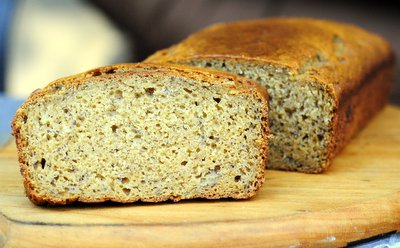
This pound cake is dense, but not too heavy, and is almost (but not quite) dry in the same way that shortbread is, since almost all of the moisture in the cake comes from butter. There are two types of leavening in this cake: baking powder and beaten egg whites. Both help the cake to rise during baking, but the beaten egg whites (a method apparently favored by Beard) can lead to a slightly uneven crumb because there will undoubtedly be some larger air bubbles in your egg whites and some small ones. Most recipes call for folding in beaten egg whites. Mine does not. The batter is so thick that it would be almost impossible to do so. Simply mix the whites in in batches using a mixer on low speed. Fold in the last small batch, if you can, and don’t worry too much if you need to use the mixer for that, as well.
The cake has a wonderful brown sugar and butter flavor, almost like butterscotch. The top of the cake, which browns wonderfully in the oven, is particularly good. I enjoyed the cake the most on the second day, after it had been wrapped in plastic wrap overnight because the “crust” of the cake was slightly softer. Eat plain or serve with ice cream, whipped cream or fruit.
+Continue Reading
Brown sugar can be a bit problematic because, when left unattended, the moist sugar can quickly transform into a rock-like state. This happens because the sugar dries out and the molasses used to keep it brown (most brown sugars are white sugars, with molasses added back) hardens and sticks it together like glue. There are several ways to avoid this problem. The easiest is by storing the soft sugar in an airtight container or ziplock bag. If it is already looking a little dry, use a terra cotta sugar disk, which will gradually release moisture into the sugar.
If your sugar has already hardened, you can either zap it in the microwave (short term solution) or add some moisture back to it by transferring it to an airtight container or bag with something slightly moist, like a damp paper towel or a sugar disc, and occasionally working with it to break it up.

Some home bakers will tell you that the secret to a good cookie is using brown sugar instead of white. I don’t think that this is actually any kind of secret at all, but I will agree that brown sugar can add a unique flavor to a cookie.
Brown sugar is basically white sugar that has had some molasses added back to it. This gives it a deeper flavor, and consequently produces more flavorful cookies. Molasses also helps to keep the cookies moist, so a cookie made with brown sugar will be slightly chewier than one made with white sugar.
I would not say that these cookies are particularly chewy, though they do remaining soft in the center even after a couple of days in the (airtight) cookie jar. I would describe them as being an excellent example of what homemade cookies should taste like. They are simple, flavorful, slightly crisp on the edges and soft in the center. They are about 1 1/2 – 2 inches across and packed with chocolate chips.
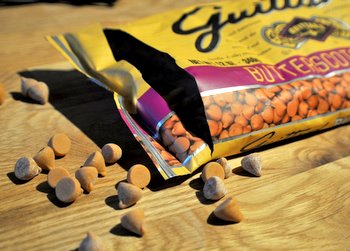
I initially thought that I would put milk chocolate chips in these cookies, but while the cookies are not overly sweet at all, even the batter tasted too sweet with milk chocolate. Try using semi-sweet or bittersweet chocolate chips in them for a good contrast.
These won’t spread out as much as you might expect, so you can fit quite a few on a sheet if you leave about an inch between each cookie.
+Continue Reading