G&S Design Lollipop Cake Pan

G&S Design Lollipop Cake Pan

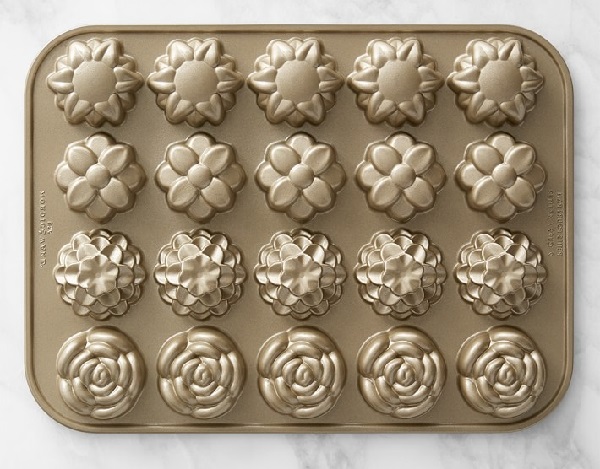
Popsicle-style cake pans - or pans that make small, flat cakes that can easily be skewered with a popsicle stick for a whimsical presentation of a cupcake - seem to be popping up all over the place lately. I’ve seen heart-shaped caksicles in addition to the classic popsicle-shaped Caksicle. The G&S Design Lollipop Cake Pan is a new spring-themed pan of the same type. The pan features three daisy-shaped cavities, three tulips and two butterflies, for a total of eight cake molds per pan. The pans are nonstick, for an easy release, and have just enough detail that the finished cakes will have a nice shape without too many nooks and crannies for the cake batter to get stuck in during baking. You can bake cake batter in these molds, but can also use them to shape cookie dough or even plain chocolate. The designs can be enjoyed year round, but really are perfect for spring and summer use.

Each pan includes a number of popsicle sticks so you’ll be ready to bake right away. Cookies, shortbread and other dense baked goods hold up well to the popsicle concept. For lighter or more delicate cakes (most, in my experience), the best way to serve these is by pairing up the shapes and sandwiching them together with frosting, inserting the stick and then dipping everything into a glaze (or melted chocolate) to coat the popsicle and keep hold everything in place.

Celtic Knot Shortbread Pan

Celtic Knot Shortbread Pan

Buttery shortbread can seem a bit plain when you compare it to cookies loaded up with chocolate chips, nuts and other goodies. I’ll take it any way it comes, because I am a big fan of shortbread when it is good, but it is worth noting that there are plenty of ways to dress up this relatively simple cookie. One way is to bake it in a specially made shortbread pan. These shallow pans have designs stamped into the bottom that emboss the shortbread dough with a pattern as it bakes. When the shortbread is done and has cooled, it can gently be turned out of the pan to reveal the design. Another plus of this type of pan is that they also have lines indicating where the shortbread pieces should be cut, or could be broke off into individual servings.

St Patrick’s Day is coming up and this Celtic Knot Shortbread Pan would be ideal for dressing up a batch of shortbread for the holiday. Its swirling Celtic designs are very pretty, and a little bit more sophisticated than a pattern that relies on four-leaf clovers to evoke the holiday. This particular pan is ceramic and comes with a booklet of shortbread recipes to use with it, though most shortbread recipes can easily be adapted to work in a pan this size and shape

Take the Cake Cake Server

Take the Cake Cake Server

When it comes to kitchen gadgets, do you put function over form? As much as I like a good-looking kitchen tool, I have to admit that I would choose a simpler tool over a decorative one. You don’t have to make that choice with the good-looking Take the Cake Cake Server, which is beautiful and still very functional. The server is made out of a single piece of mirrored stainless steel, with one end that acts as a handle and one that acts as both a knife and tongs. You simply press the wide end of the cutter down into any round cake, making a slice about 2-inches wide, then gently squeeze the handle end together as you lift the spice out, creating just enough pressure to pick it straight up and transfer it to a plate (or a napkin for immediate consumption!).

The server is about 9-inches long and 2-inches wide. You could easily store it in a drawer, but I would definitely consider hanging on a wall to display until I needed it to serve dessert.

Dial-a-Slice Fruit Corer and Wedger

Dial-a-Slice Fruit Corer and Wedger

The most time consuming part of making an apple pie is prepping the fruit. The apples need to be cored, peeled and sliced - and when you’re talking about 6 or more apples, that turns into quite a bit of work! This is the reason that tools like fruit wedgers exist, to make it even easier to slice up those apples (or any similar sized fruit) once they are otherwise ready to go. This particular tool, the Dial-a-Slice Fruit Corer and Wedger has an unusual feature to it: you can adjust the size of the slices because there are two sets of blades, so you’re not stuck with one size of fruit slice. It’s funny how a simple change like this can really expand your options and make a tool a little more useful. The Dial-a-Slice cuts either 8 thick wedges or 16 thin ones. Use the thin wedges for cakes, tarts, muffins and other quick cooking desserts. The thicker wedges are better for pies and cobblers, but you can use a mix of thick and thin if you like to have a variety of slightly crisp thick pieces and ultra-tender thin ones in your desserts.

CR rates hand mixers

KitchenAid Architect Series mixer

I have had my trusty KitchenAid hand mixer for more than a few years. In fact, I actually don’t remember when I first got it, only that it has help up very well and works well. This is a good testament to the longevity of my model, but hand mixers can actually vary a lot in size, power and their ability to get the job done in the kitchen, whether you’re beating egg whites or mixing cookie dough. In their most recent issue (March 2010), Consumer Reports put nine different hand mixers to the test to see which were the best.

The compared the mixers on several features: whipping time (heavy cream), mixing ability (cookie dough), convenience and noise.The top finished was a KitchenAid Architect Series model, with lots of speed, great turning power and a quiet motor, it was easy to use and whipped up cream in less than half the time of some of the low-finishing models. It is also the most expensive mixer tested, so it is worth noting that the second place finisher - a KitchenAid UltraPower 5 - was $30 less and performed just about as well, although it was a touch less powerful.

They also noted that most of these models are available with additional attachments, including whisks and dough hooks, which are well worth looking for if you don’t have a stand mixer and want to get a lot more versatility from your hand mixer! Ratings for all models tested are listed below:

(more…)

Cake Pan Gripper

Cake Pan Gripper

Some cake pans and baking dishes have handles that make them easy to slide out of the oven when the baking time for your cake, casserole or other dish is up. Other pans have virtually no edge beyond a thin roll of metal at the top of the pan. It can be very difficult to get a good grip on these pans when pulling them out of the oven, especially when you’re wearing thick, chunky potholders that don’t give you a lot of flexibility of movement. I know that there have been many times when I’ve touched the top of a high-rising cake - deflating a small portion of it in the process - much too firmly with a mitt-clad hand in my attempts to get the pan out of the oven.

Occasionally, I’ve used tongs or a knife to slide the pan to a flat surface, such as a wire rack, that I can more easily lift it from. There is a gadget out there that is specially purposed for solving this problem, however. It’s called a Cake Pan Gripper (scroll down on the linked page to see it). The spring-loaded gripper is made of a heat resistant material and has what looks like a small lobster claw on the end. It fits over the vast majority of rolled-edge pans and gives you a very strong grip, enabling you to lift the cake out of the oven.

I still wouldn’t rely on this entirely with a very heavy cake, but you could still easily use it to grip the pan and pull it safely to a spot where you can take a better hold of it. No burns from the oven and no deflating the cake with a misplaced finger or edge of a potholder.