
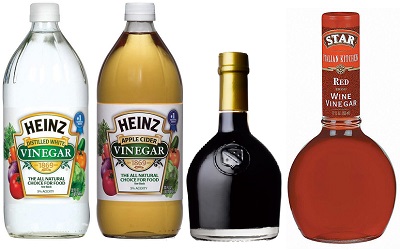
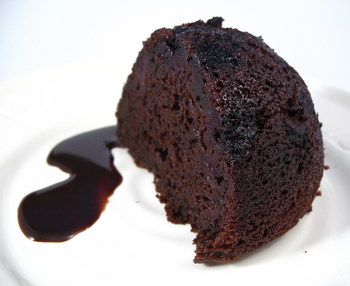
Vinegar is a surprisingly common ingredient in baked goods, considering that it has such a sharp flavor. But as an acid, vinegar is often included in cake and cookie batters to react with baking soda and start the chemical reaction needed to produce carbon dioxide and give those batters a lift as they bake. One of my favorite cake recipes takes advantage of this reaction: eggless chocolate cake. You can’t tell that the cake has vinegar in it when you taste the finished product and people are often surprised to hear that vinegar was included at all.
The two most frequently used in baking are white vinegar and apple cider vinegar. White vinegar has a sharp, even harsh, flavor if tasted alone, but it is a very simple flavor and does not really stand out when used in a complex batter. Cider vinegar, made from apples, has a faintly fruity flavor and is quite sweet compared to other types of vinegar. It’s very mild and works even better in batters because there is virtually no chance of any vinegar flavor surfacing in the finished product. Cider vinegar is my top choice in baking, but I don’t have a problem using white vinegar, either.
Balsamic vinegar is very popular at the moment and readers often ask if it can be used in place of other types of vinegar in recipes. The general rule here is that a recipe will call for balsamic if balsamic should be used. It can be used in other baking applications, but you should keep in mind that the flavor of balsamic vinegar is stronger than most other types of vinegar and it actually can show up in a finished product – especially if the cake is mildly flavored to begin with. Unless I wanted to play up the tangy flavor of the vinegar, or use it to contrast with a naturally sweet fruit, I would opt for white or cider before balsamic in most baked goods.



Lisa
August 1, 2008Huh! I just barely made a batch of black bottom cupcakes using the “wacky cake” recipe with vinegar! It always turns out so moist and perfectly light! I love that you can use vinegar! It’s great for when you want to bake but your out of eggs!
Stephanie
August 1, 2008Thanks for the primer on vinegar! I always wonder why it’s included in many recipes…and now I know.
On a side note…I see that you went to Berkeley, a place that warms my heart as well. Go Bears!
Nate
August 1, 2008Since balsamic and strawberries seems to be very popular these days, I wonder if balsamic could be used in things like strawberry tarts. Have you seen recipes like this?
Jena
August 2, 2008I had a recipe that called for white balsamic, but I could not find it anywhere. Is there a sub for it? Or where is a good place to buy it?
Allison
August 4, 2008I usually substitute coffee for vinegar in chocolate-based recipes that call for vinegar.
Yvonne
August 1, 2009So that’s how it works~~~ How bout distilled white vinegar? is it really important to use distilled ones as stated in some recipes?
Kulsum at JourneyKitchen
March 16, 2011thanks for a very informative post!
Rochelle Amaro
June 26, 2011Can you use vinegar in a recipe that doesn’t call for it?
Kris
August 9, 2011http://tipnut.com/egg-substitutes/
This site gives the ratios for substituting per one egg. It recommends not to try it with a recipe that uses more than 2 eggs. If a recipe does not call for vinegar, but calls for eggs, then go for!
Sophia @ NY Foodgasm
February 12, 2013Thanks for the info! I always wondered about vinegar in recipes! I was like really? Ewww vinigar! LOL!
MommaJ
April 30, 2013Wow, I have been trying to figure out how my cake was so moist and what caused it to be so great with out the eggs, As another spoke of, Wacky Cake is one of our families favorite Chocolate Cake Recipes I make from scratch, but I didn’t know what the vinegar was all about. Thank you so much for this lesson for me to keep close to me when baking and choosing recipes.
Judith
October 15, 2013Thank you. Couldn’t understand why vinegar would be used in a cake batter. The fact that it creates a chemical reaction with baking soda makes perfect sense.
I_Fortuna
January 3, 2014Buttermilk also works with baking soda for leavening. You can still use eggs. Eggs bind foods but they are not meant as a leavening agent. Vinegar can be added to milk to acheive similar results as buttermilk, however, cultured low fat buttermilk is thick and divine for all baked goods in my experience. Since I used it a long time ago for Irish soda bread, I use it only or a blend with milk or flax milk.