
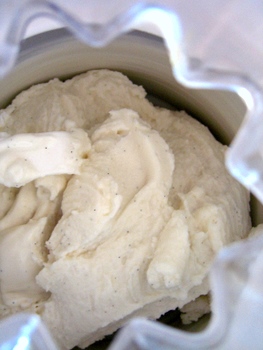
Making homemade ice creams and frozen yogurts is fun, but even when you have a good quality ice cream maker, there can be some difficulties with the process. The top two concerns that people have are (1) the ice cream is too soft and (2) the ice cream is too hard.
Ice cream made in a machine designed for home use often doesn’t freeze ice cream to the consistency of store-bought ice cream, and while it is still scoopable right out of the machine, the fact that it is a bit softer can put some people off. My ice cream maker has a frozen “core” that chills the ice cream as it churns. It also becomes less cold the longer that the machine is on, so there is a point at which my ice cream mixture simply will not get any firmer. The reason for this lack of firmness compared to commercial ice cream largely has to do with the fact that commercial ice creams have spent lots of time in extremely cold freezers (even at the grocery store), while a fresh homemade ice cream has not. Almost all recipes will direct you to further chill your finished product to firm it up even more after it comes out of the ice cream maker.
At the opposite end of the spectrum is the problem of homemade ice cream being too firm, especially after it has been stored in the freezer for a while. Some say that fat content will keep ice cream creamy and soft. This is true (especially when it comes to keeping the ice cream creamy) but one of the keys to a scoopable ice cream is actually the amount of air in the mixture. The more air that is distributed into the mix, the easier it will be to soften the ice cream and to scoop it. Home ice cream makers don’t work at the speed of commercial machines, and often less air gets incorporated into the mix overall. Adding a bit of vodka or other alcohol (as I did here) can lower the freezing point of the ice cream and help to keep it from hardening too much, but really the only way to beat this problem entirely is to have patience and thaw your ice cream for half an hour or so before indulging.
If you need a starting place for great ice cream recipes, check out my book, How to Make Ice Cream!



katy
August 15, 2008Ohhh, very helpful post. I did kind of wonder why my homemade fro yo needs to be hacked to pieces with a chisel to pry off enough for a small bowl after it’s been sitting in my freezer for a day or two. I thought it was the fat-content problem, but this makes much more sense!
kittymama
August 16, 2008My problem is not the hardness as much as the fact that if I churn my ice cream for 20 minutes, like the manual says, it always ends up grainy. I pull mine out somewhere between 12-16 minutes. But for many years, I just thought homemade ice cream was grainy. I never hear anyone else discuss this. Am I the only one or am I doing something wrong? I have tried several machines and many recipes. I don’t have a problem taking it out earlier, I just don’t understand why they tell us 20 mins when that’s too long in my opinion.
Nicole
August 16, 2008kittymama – I’m not sure what you mean by grainy, so I’ll assume that it is one of two things. (a) The sugar in your ice cream mixture is not fully dissolved before it goes into the mixer or (b) the graininess that you’re referring to is from ice crystals.
Far more ice crystals form in homemade ice cream than commercial because the at-home machines don’t freeze a mixture as quickly or efficiently as big commercial machines. This gives ice crystals more time to form and, yes, can contribute to a texture that is less than perfectly smooth. You’re right that churning for less time can help the problem. It doesn’t really matter what the manual says; churn your ice cream until it is as close to the consistency you like as you can get it, then enjoy!
Wla
August 24, 2008I had a problem with ice crystals, too. After doing some research, I learned that water in the ice cream mixture will separate after the ice cream has been mixed, then freeze to form crystals. Commercial ice cream makers use a quick “flash freeze” process to prevent this. So I tried placing the ice cream bucket in an ice chest with dry ice and regular ice to freeze the mixture quickly and found that this minimized the presence of ice crystals. I used a small amount of dry ice from Smart & Final.
Heidi
January 6, 2009Does it make a difference in the freezing process if you use snow or ice for freezing ? Ours never reached a mashed potatoe consistancy even after an hr of freesing
Diane George
April 6, 2009I had a problem with “grainy” ice cream also. I let the machine churn the ice cream for 30 minutes. I guess this is too long. Any other tips besides more cream will be useful.
Lisa S.
July 3, 2009I just made some ice cream for the first time and could use a little advice. The finished product tasted like frozen ice crystals and frozen butter. The ice cream wasn’t very sweet, but the main issue is the texture, could this be due to the over mixing mentioned earlier in this post? I was wondering if chilling the cooked custard overnight could have caused it to seperate? Any advice anyone?
Deborah
October 7, 2009My ice cream issue is similar to Lisa’s in that I seem to have tiny globules of butter in my ice cream. It tastes good and is plenty sweet, but there’s definitely something wrong with the fat. My (butternut squash ice cream) recipe called for 2 yolks, a cup of heavy cream, and 1/2 cup of milk. It felt like tiny chunks of butter and left a film of buttery ick in my mouth. I chilled the mix for a couple hours before churning. Anyone have any suggestions? Should I use a lighter cream or maybe half and half instead of cream? Thanks!
RobertY
October 8, 2009Deborah…I have made ice cream and have tried figuring out what the commercial ice cream makers do different compared to homemade ice cream.
I found out that Breyers actually mixes liquid nitrogen into their mix to aerate it and almost instantly cool it. This way they get around using preservatives and the butterfat gets dispersed evenly in the mix. Obviously liquid nitrogen is out of the question for us…
But I have seen that a lot of them use lecithin ( a soy based emulsifier you can buy by the quart in health food area of groceries) . They use this to suspend the butterfat in the mix without it separating out. It also preserves the fat longer in the mix by coating each particle and keeping oxygen from it.
Try adding at least a tablespoon of lecithin to your batch next time. You might need more (it has no taste) since you need more based on cream content. Work your way up on it (2-3 tbls) to find a good balance
marjorie
August 23, 2010To get rid of the ice crystals in the ice cream try putting the mix in the refridgerator for half an hour or so before freezing it. That worked for us. I forget what needs to be cooled slowing, but it works. Goodluck.
Mairaj
June 13, 2011Could any one tell me that what is the liquid found inside the freezer bowl of ice cream makers. Mine has leaked so i wish to fill it up as i have found an opening.
Susie H
July 18, 2011MAIRAJ
I have alarm bells ringing at the thought of the fluid leaking….I’m really not sure but I THINK it may be bad news if consumed, so I personally would want professional advice before trying to refill and continue using your machine. Sorry to sound pessimistic but I suspect you may have to discard your machine. Do seek proper advice as I’d hate for you or your friends or family to be hurt in any way. I hope I prove to be wrong!
Jerusha
August 6, 2011I just made a batch of ice cream, loosely based on Ben and Jerry’s Cherry Garcia. I say loosely because I used Montmorellancy cherries from my tree, and cream and milk from my goats. I sweetened the cherries and kept them soft in the ice cream by poaching them in sugar and cherry brandy. Yum! I chopped up a bagful of Lindt extra dark chocolate truffles, figuring they’d stay softer than most chocolate bits would. It tastes fantastic! I usually have problems with too much fat making the ice cream coat my tongue unpleasantly, but not this time.
Problem is I can’t scoop up a ball of the ice cream to eat in a cone. It didn’t freeze too hard, but it kind of crumbles and falls apart when I try to scoop some up. It doesn’t have the tendency to stick to itself that mos ice cream does. I’ve never seen anything like this. Was it the brandy? I drained it off the cherries before adding them. I’m stumped. Any suggestions?
Jerusha – It sounds like your ice cream may simply have been too hard or there may not have been enough sugar in it. You don’t say if there was sugar in your base, or not, but sugar has a huge impact on the consistency of ice cream
Natkat
September 15, 2011My problem is that the mix clumps up on top of the paddle aand stays there. Obviously it’s too thick, but what can I do to fix it?
Yoni
October 28, 2011Ironic, I am about to purchase a new ice cream machine. My other was hand churn. Found this site when I entered ‘grainy’ ice cream, because I absolutely love the texture and I’m concerned an electric ice cream maker will cause it to be too smooth for my tastes. I am not an ice cream lover except for homemade vanilla, so my opinion isn’t real relevant – other than some of us love the grainy texture, which brings back my child hood memories.
Inez
November 5, 2011Jerusha and others:
You may resolve your dilemma if you post it over at chowhound.com. Some of the smartest and most responsive cooks congregate there. (You have to sign in to post.)
And no, I’m not affiliated with the site. ‘Just speaking from help I’ve received there w/my own kitchen calamities.
nancy
January 3, 2012We’ve made home made ice cream for years but recently when you get to the bottom of the container, the ice cream seems to have separated and the bottom of the container is thick, creamy and not as good. My recipe calls for half and half, whipping cream and whole milk. We fill to the line marked but could the container be over filled? Also we wrap the container in several brown paper bags and keep in freezer above the fridge; this keeps the ice cream from crystalizing.
Nancy – Your ice cream separates in the freezer after churning, or during churning? If it is during churning, your container could be overfilled or underfilled. If it separates after churning and while in the freezer, it sounds like there may be a flaw in your freezer
Kevin
July 25, 2012I just made a batch of maple walnut ice cream with the same problem that Jerusha describes. I can’t find any suggestions anywhere as to what the cause might be.
I used the same base as always which, I’ve never had any problems with before, the only difference being I replaced the sugar with pure maple syrup per several recipes I found online.
Nicole
July 26, 2012Jerusha and Kevin – A crumbly texture in ice cream can result from overchurning (getting too much air into the mix) and not letting the ice cream soften enough before scooping. The texture of the base – for instance, not having enough solids in your mix, or having too many additional ingredients – can cause ice cream to take on too much air when churned. Try not churning your ice cream quite as long next time and putting it into the freezer right away to firm up after churning. This should help with the problem.
Bob
August 26, 2012My problem is that the mix freezes hard about one inch into the can but the center does not freeze even after mixing for at least an hour. I cannot figure out the problem.
fred
February 8, 2013My problem is that the machine runs and goes off before the ice cream is ready to be dispensed.
Nicole
November 18, 2013Bob – In a home ice cream maker, it is unlikely that your ice cream will freeze to a completely “solid” consistency. In fact, continuing to churn it can actually cause it to start to melt. Usually, ice cream is churned and then transferred to the freezer to firm up.
Fred – Your ice cream may need to be transferred to the freezer to firm up after churning. This is a common step for most home ice cream makers.
Ayuki
November 20, 2013I was wondering if anyone knows how to correct an ice-cream base. I was doing the recipe for Black Sesame Ice-cream and when it came to the thickening to the custard stage in order to make the ice-cream, it was still runny and thin and I have no idea on how to thicken it without compromising the whole batch. I have put it on low heat and the eggs didn’t scramble at all, so I don’t know what I’m doing wrong here. If anyone would respond to me as soon as possible would be appreciated greatly.
Thank you for reading this.
Nicole
November 21, 2013Ayuki – Some custard bases are not as thick as others are, it really depends on a ratio of eggs to milk/cream in your recipe (1 egg, for instance, will not substantially thicken three cups of liquid). If your ice cream base has a good deal of liquid, it may be that it is just a thinner custard and should churn just fine.
Walker
June 25, 2014I love how long this string is and how helpful! I came here because my peach ice-cream wouldn’t freeze. I let it run way past the 20-40 minutes noted in the manual but only got a milkshake consistency. I then poured out the batter and put it in the frig while I tried to figure out what went wrong. I use a Hamilton Beach “freeze-the-canister” ice-cream maker. It has always worked in the past, but this time–failure!…anyway, my point in posting this comment is that I didn’t know if I could save the ice-cream batter, properly freeze the canister, and re-freeze the ice-cream. So, I turned up the freezer by 1 notch, kept the batter in the coldest part of the refrigerator and placed all of the ice-cream makers parts in the frig overnight. This morning, I put everything together, turned on the machine and poured the batter. It was done in 15 minutes!
I’m sure that many of you long-time ice-cream makers already have done this successfully, but I was so happy that it worked that I had to tell someone.
I actually think that refrigerating the batter, with the peach mixture in it improved the flavor of the ice-cream, but that’s just me.
catherine
September 3, 2015I actually just started making homemade ice cream for the fourth of July and had my family over. I made 5 different flavors with about 15 toppings, mostly homemade. I don’t like eggs in ice cream so I usually look for recipes that don’t require eggs. They really enjoyed it. But since then I have had problems with my ice cream coming out good. I’m having a problem with buttery lumps being in the ice cream. I really enjoy making this delicious treat but have been very disappointed lately. Please help!!!!!!!!
Nicole
September 3, 2015Hi Catherine, Buttery lumps generally result from an ice cream being too high in dairy fat. For instance, churning plain cream will have quite a lot of lumps! I have also seen people reduce sugar too much in an effort to obtain ice cream that is “not too sweet” end up with lumps. I’m not sure what types of recipes you are using, but I would recommend that you look for recipes that have a a mix of both milk and cream, as well as sugar.
My book, How to Make Ice Cream, has lots of recipes for egg-free ice creams that you might want to check out!