
Archive for: irish soda bread

What is Irish soda bread?

Irish soda bread

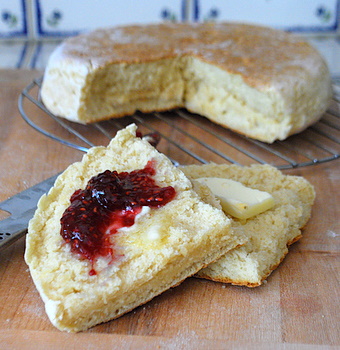
Irish soda bread – or just soda bread, if you prefer – is a type of quick bread that uses baking soda as a leavener. While this may not seem like much of a revelation these days due to the prevalence of baking soda in all kinds of recipes, it was a boon to bakers in Ireland in the mid 1800s. At that time, Ireland did not have a strong tradition of yeast breadmaking because, unlike many other European countries, the country did not produce much of the high-protein (hard wheat) flour necessary for making good yeast breads. When baking soda was introduced to the country, it pretty much replaced yeast. It produced a reliable rise in the oven, made tasty loaves of bread and would work perfectly with the softer Irish flour.

Soda bread has four basic ingredients: flour, buttermilk, baking soda and salt.  The reaction between the buttermilk and baking soda produces bubbles of carbon dioxide, causing the dough to rise. The breads are fairly dense, moist and hearty (and satisfying for a cold and damp climate!). Moving beyond the basic elements, they can be flavored in any number of ways. Today, the breads often contain additional ingredients, like sugar, butter, currants or caraway seeds to enhance the flavor and texture of the bread. It is best served the day that it is made, when the crust is crisp from the oven, with plenty of salted Irish butter.

Traditional Irish Soda Bread

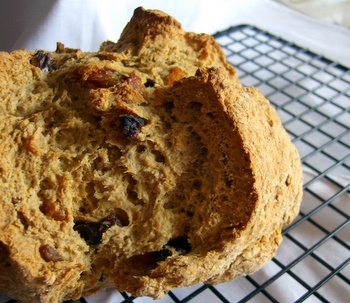
The New York Times ran an article this week about traditional Irish soda bread – or rather, they ran an article that discussed how the loaf presented as “traditional” in the US is often not. The author’s loaf had butter, sugar and eggs in it, as well as raisins, and turned into a very cake-like loaf. I myself am guilty, to a degree, of making a less-than-traditional loaf. I don’t use butter or eggs, but I usually add a bit of sugar, caraway seeds and raisins. Not that there’s anything wrong with that, of course, it is good to know that the Irish soda bread that I typically make is a variation on the standard, not the standard itself.

The article hinted at the fact that the traditional recipe used only flour, buttermilk, salt and baking soda, but for some reason failed to include the recipe (it did include the cake-like version, however). I thought I’d step up and fill in the gap. I took out all the extraneous ingredients from my usual recipe and whittled it down to a plain, basic traditional loaf.

The bread is best when it is warm and comes out of the oven with a crisp crust and a tender interior. It is easy to taste the buttermilk in the loaf, but it is very plain bread. I like it with soup, where it can sop up broth, or cut into slices (I often simply pull pieces off the loaf) and topped with butter or jam. Irish butter is usually salted and will taste better with the bread than unsalted butter.

+Continue Reading

Irish Soda Bread with Raisins

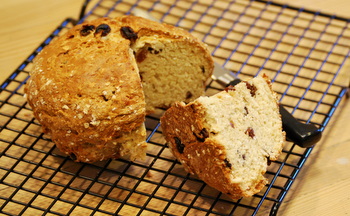
Irish soda bread is dead easy to make. It can have as few as four ingredients and uses no yeast, relying instead on the reaction between baking soda and buttermilk for leavening. This produces a reliable rise every time, no matter how inexperienced you are are baking. The four base ingredients are flour, buttermilk, baking soda and salt.

Irish soda breads are slightly denser than most breads because they have no yeast. They do no have the means to develop any of the nice, open holes that can be seen in, for example, french baguettes. The loaves are very quick to make, however, and the slight denseness makes them tasty and unique. Ths hearty bread pairs well with soups and meat dishes. The crust that develops as it bakes means that it makes outstanding toast, too.

Another good thing about soda bread is that it is versatile, especially in terns of flavors. While the base can be very plain, you can add carraway, which is fairly traditional, or currants for a sweeter bread. I like adding a mixed variety of raisins to mine and a pinch of sugar, which helps with browning. Some people use all whole wheat flour in their soda breads and others like to keep them lighter by using only all-purpose flour. While any combination of all purpose and whole wheat flours will work, the best variation, in my opinion, uses 1 1/4 cups all-purpose flour, 1/2 cup whole wheat flour and 1/4 cup oat flour. The whole wheat flour gives it a distinctive taste and the oat flour keeps the bread a little bit moist.

Whip this up when you walk in the door after work and let it cool while you prepare dinner. The bread should be cooled completely or almost completely before slicing.

+Continue Reading