
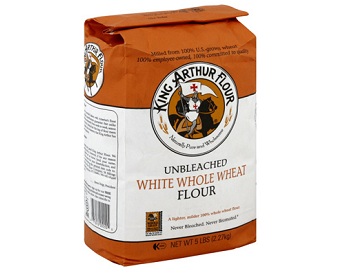
White whole wheat flour almost sounds like a misnomer. Whole grain flours, and baked goods made with them, are supposed to be brown and noticeably darker than baked goods made with processed white flour, right? White whole wheat flour has been becoming steadily more popular over the past few years as interest in whole grains and whole grain baking continues to rise. It has gone from a specialty item to a pantry staple for many.
White whole wheat flour is made from a naturally occurring albino variety of wheat, so it has a whitish outer bran (hence the name, white whole wheat) to it where regular wheat has a darker brown or reddish bran. This bran usually contains tannins and phenolic acid, which are what give whole wheat flour the slightly bitter taste that is often associated it, but white whole wheat contains none. As a result, it has a mild, sweet and slightly nutty flavor without a trace of bitterness and is much more similar in flavor and color to all purpose flour than to traditional whole wheat flour.
White whole wheat still has all the same nutritional benefits of whole wheat flour because it is made in exactly the same way, and so it has more fiber, vitamins and minerals than most all purpose flours to. It can be used in any recipe that calls for whole wheat flour and, because it has a lighter flavor, will generally give you an even tastier result than whole wheat will. Like whole wheat flour, it can be used to replace part (25-50% is a good start) of the all purpose flour in a regular recipe if you want to infuse some whole grain into your cookies, yeast breads or cakes. Since it has that milder flavor, in cookies and muffins – baked goods where you’re not looking for that ultra-light texture you might want in a cake – you can substitute all of the all purpose flour in the recipe with white whole wheat for a slightly heartier variation.



the wicked noodle
October 1, 2010I have never heard of white whole wheat flour, but I’ll be on the lookout for it now! Thanks for the info 🙂
Jennifer @ Jennifer's Treasured Recipes
October 1, 2010Ah! So that’s what it is! I’ve seen white whole wheat flour listed as an ingredient before, but I wasn’t sure what made it so special until now. Thanks for the info!
Brandis
October 1, 2010I just wanted to add that it isn’t processed EXACTLY like whole wheat flour. The entire grain is processed, as in whole wheat flour, but the milling process is different. I don’t know exactly how, because it’s kind of a secret. My husband actually works for the company who developed this method to utilize this albino hybrid of wheat.
I have used the flour and like it, but I am concerned about the difference in the wheats and any possible drawbacks of the more involved processing. If we do ever discover drawbacks I doubt it will be anything huge, but I still prefer regular whole wheat flour.
April
October 1, 2010I love white whole wheat flour. I usually replace half of the ap flour with it in scones, muffins, and cookies. It makes a slight taste difference but one that I prefer.
Lauren at KeepItSweet
October 1, 2010i actually never knew this…. i keep buying white whole wheat flour thinking it is regular whole wheat and then realizing at home that it isn’t. glad to know the nutrition is the same!
Nicole
October 1, 2010Brandis – Thanks for the additional info!
BeckyS
October 2, 2010King Arthur is the best flour in my book and their white whole wheat is great! I hope everyone will give this a try, you won’t be disappointed!
Lauren
October 2, 2010Thank you so much for this post! Whenever I post a recipe that calls for white whole wheat flour, I am asked a bunch of questions about that particular ingredient. From now on, I will direct my readers to your thorough & helpful explanation!
Hannah
October 7, 2010Interesting! I had wondered about this. So, is this albino wheat the same as the hard white wheat berries (such as Prairie Gold) that are readily available for the baker to mill at home themselves, or is it entirely different?
Love From The Oven
February 16, 2011Love love love the white whole wheat flour. I use it for all off the recipes I make for us to eat at home. I still use regular flour when I’m baking for gifts and goodies to give, but that’s it. It is a fabulous product. Breads, cookies, muffins, I’ve made all of them with it and while I sometimes have to adjust the liquids a bit, it works out great and my picky daughter doesn’t object – which is the seal of approval around here! 🙂
Melissa
January 6, 2012Thank you for educating me with such a clear explanation.
Mary
July 16, 2012White whole wheat flour has become our favorite. I make bread using all wwwf instead of having to substitute half white bread flour like you do when using regular ww flour . It turns out great.
Barbara Mitchell
June 18, 2013My recipe calls for white flour but I only have whole wheat flour do I use the same amount
Nicole
June 18, 2013Barbara – You might need to use a little less whole wheat flour, depending on what type of recipe you are making, because whole wheat flour can make the dough/batter a little drier. But you will need about the same amount.
Pat Round
June 7, 2015We recently started using whole wheat for everything (on Dr’s advice) and found that there is not much difference in taste. I do a lot of “scratch” baking so I was happy about this. We also found that whole wheat pasta tastes the same as regular pasta.
Jill Roberts @ WellnessGeeky
December 19, 2017Hey! Someone tasted this white whole wheat flour, cuz I have never heard about it?