Filed under Cooking by Nicole | 4 comments

Browned butter is made by cooking butter until the milk solids in the butter begin to toast and turn a lovely brown color. This is typically done on the stove in a sauce pan, over medium or medium-low heat where it can be watched closely for color and doneness. The solids in the butter can go from toasted to burnt very quickly. This is a fine way to brown butter, just as using a double boiler is a fine way to melt chocolate. Now, chocolate can be melted more quickly in the microwave as long as you keep an eye on it to prevent it from burning. The same is true for butter: it can easily be browned in the microwave.
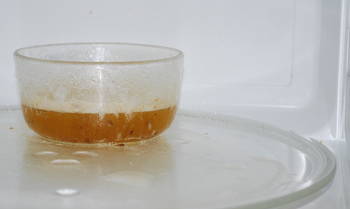
Put your butter into a large, microwave safe dish and heat it in 1-minute intervals in the microwave, checking after the second minute to look for brownness bubbling away at the bottom of the dish. Try using a 4-cup size bowl for 1 cup or less of butter because the butter will puff up and expand as it cooks, and will definitely bubble over the top of the bowl if you aren’t using one that is large enough. The whole process will take about 3-4 minutes, depending on how much butter you’re cooking. You’ll see lots of brown flecks floating in the butter when it is done (these are the milk solids). Once the butter is cooled, you’re ready to incorporate it into any recipe.
Filed under Gear and Gadgets by Nicole | 0 comments

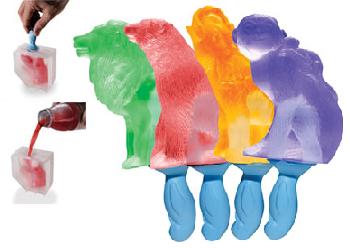
Summer is officially over, as of a few days ago. Fortunately, a mark on a calendar doesn’t mean that we get an instantaneous change in the seasons, so there is still time to enjoy the rest of the warm weather while it lasts. Ice cream, frozen yogurt and popsicles are all still fair game - although it would have been nice to get a set of these adorable Zoo Pops a little earlier in the year.
These popsicles are shaped like zoo animals: a lion, a polar bear, an elephant and a monkey. While not drawn to scale, the details on the animals are great, giving them a much fancier look than your average popsicle. Complex shapes like these wouldn’t really work in a standard popsicle mold, so the molds for these popsicles are quite unique. Each one stands alone and opens a bit like a book to reveal the animal shape inside. The halves of the mold are locked together before being filled with juice or some other popsicle base and frozen. The book is simply snapped open later to pop out the fully-formed shape, which means that not only do you get a cool looking treat, but there is no need to fight with the mold (dunking it in hot water, etc.) in an effort to pull a popsicle out for serving..
Filed under Recipes, Pies, Pie and Tart Crusts by Nicole | 16 comments

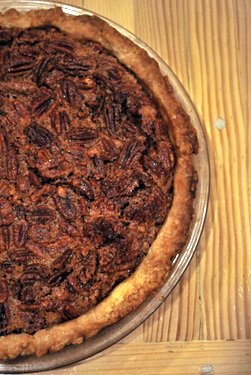
Pecan pie is not my favorite fall pie. That spot is permanently taken by pumpkin pie. But it becomes boring to have only one type of pie around, especially during the holidays. I vary my options with apple pie, lemon meringue pie and, as in this case, pecan pie.
Corn syrup is the traditional base for a pecan pie, but I didn’t want to use it in mine and looked for alternatives. While it provides a pleasing consistency to this type of pie, corn syrup is just too sweet and too one-dimensional for my tastes. It doesn’t add all that much to the pie, and lack of depth is one of the things that I don’t like to see in a pecan pie. I found one promising recipe in an old issue of Gourmet that used maple syrup instead of corn syrup. Maple and pecans go amazingly well together, so this recipe sounded like a winner right off the bat. The ingredient list is short and the method here is dead easy. The only real change I made to the original recipe was in the nuts. I used more nuts than the recipe called for and used pecans that had been previously roasted and salted. Pecan pie is definitely a sweet dessert, but salty-sweet is better in my book and using slightly salty pecans gives the pie a nice balance.
The combination of all the elements worked out beautifully. The hint of saltiness that the roasted/salted pecans added to the filling really took the edge off the sweetness of the syrup base, just like sea salt does to a caramel. The maple syrup gave the pie a fantastic fall flavor and made for a much more interesting dessert than a corn syrup-based pie. My standard maple syrup is “Grade B” because it has a richer color than the “Grade A” or “light amber” syrups. That said, any type of real maple syrup (not maple-flavored pancake syrup, which is just corn syrup) will work for this recipe. For the crust, I used my standard all-butter recipe. It doesn’t take long to make and only needs about 30 minutes to chill before working it. To save time, however, you can start with a frozen pie crust that has been defrosted.
(more…)
Filed under Magazines & Cookbooks by Nicole | 5 comments
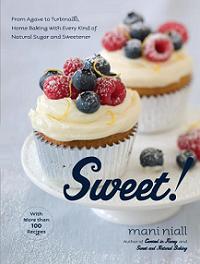
Sugar is not the only option when it comes to sweeteners for baking. Other sweeteners, natural sweeteners, have spread from the shelves of specialty stores to more mainstream ones, where they are more accessible than ever before. Agave syrup, for instance, is just one of many. The only drawback to having all these items available is that it can be difficult to figure out how to use them. Sugar will always be one of the mainstays of baking. Not only do most recipes call for it, but you can’t simply substitute any old natural sweetener in a sugar-based recipe and get similar results. Every sweetener has its own unique properties and requires special attention. Sweet!: From Agave to Turbinado, Home Baking with Every Kind of Natural Sugar and Sweetener is a cookbook that gives these sweeteners plenty of attention.
The cookbook starts off with a discussion of sugars and why they’re so important to baking, to give the book a jumping off place for a discussion of other sugars/sweeteners and the characteristics that they can impart to a baked good. There are some recipes that use everyday sugars, and from there the recipes go on to include “specialty” sugars like demerara and muscovado, as well as other sweeteners. Some recipes call for a mix of sweeteners, while others only use sugar alternatives. Recipe categories include breakfasts, cakes, pies, custards, candies and frozen desserts, and there are even a few savory/main dish selections included to show the sweeteners’ versatility.
The cookbook is written by Mani Niall, the author of Sweet and Natural Baking and founder of Mani’s Bakery in LA, which specializes in using all natural sweeteners (and other healthy, all natural ingredients) in its cakes, cookies and other baked goods. There is something of a healthy slant to the cookbook, but it seems to be less overt than in the previous book. The recipes are easy to follow and most sound tempting, so it’s easy to see how a cookbook like this one could end up being something of a driving force in motivating home bakers to move out of a rut and experiment with something new in the kitchen.
Filed under Recipes, Breakfasts by Nicole | 5 comments

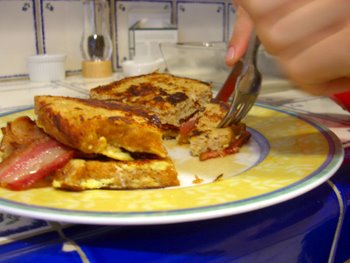
There are many out there who would argue that a good weekend breakfast isn’t complete without a side of bacon. Vegans, I think, would disagree, although there is an argument to be made here for soy bacon, too. Eggs and bacon, waffles and bacon, pancakes and bacon, french toast and bacon, bacon and bacon… This breakfast treat goes a step beyond a side of bacon and actually works bacon into a main dish: a French Toast and Bacon Sandwich.
The execution isn’t difficult. All you really need to do is stack up two pieces of french toast with a few slices of bacon in between them, douse with maple syrup and serve. It’s a great blend of salty and sweet and, while it sounds really indulgent, it’s not any different than having the two items separately.
This is the kind of treat that I make once in a while for visiting relatives, or when someone’s birthday rolls around and I want to make them a special breakfast. It’s easy to make and it’s lots of fun to watch the look on someone’s face when you put a plate down in front of them.
(more…)
Filed under Recipes, Breakfasts, Pastries, Muffins by Nicole | 42 comments

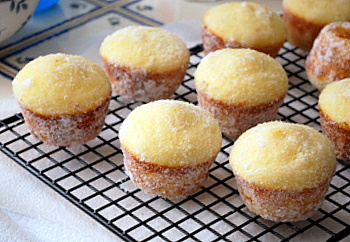
While a donut with white frosting and a generous topping of rainbow sprinkles was never turned down, sugar donuts were always my favorite when I was a kid. I liked the subtle crunch of all that extra sugar on top of a light, fluffy donut. They’re still a top choice for me now, although I think they’ve lost their top ranking to plain, old-fashioned cake donuts. These sugar-topped donut muffins combine the best features of these two types of donut in a package that is easy to make and far lower in fat than a deep-fried pastry because it is baked in the oven.
The muffins in question here are fairly plain, with just a hint of nutmeg and splash of vanilla. Once baked, they are rolled in sugar and left to set a bit before being served. The result is a muffin with a fairly crisp outer layer that is very similar to the coating on a sugar donut. Sugar donuts typically use a yeasted dough. These use a fairly typical muffin batter to produce what would be a cakey donut. I used oil in the batter to help keep the muffins moist inside, imitating their deep-fried namesakes.
The oil has a second function here, too. It keeps the sides and base of the muffin soft - softer than using butter, since butter will caramelize with the muffin’s sugar while in the oven and eventually firm up the sides that are in contact with the muffin pan. This softness is important because it provides a good surface for sugar to stick to when you’re roling the muffins in sugar. Many donut muffin recipes that I’ve seen in the past call for a muffin to be dunked in butter before being rolled in sugar. This is effective, but not entirely necessary (especially since it adds quite a bit of fat to the recipe). Plenty of sugar will stick to a hot-from-the-oven muffin without applying any butter to its sides and base. I prefer to brush the top of the muffin with just a little bit of butter, then roll the whole thing in sugar. Be careful with your fingers when you handle the hot muffins, and place them on a wire cooling rack after dipping them to let the sugar fully adhere.
(more…)