
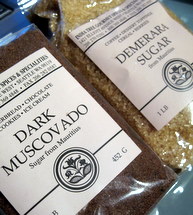
 When it comes to baking, recipes mostly call for powdered/confectioners’ sugar, plain sugar or brown sugar. The textures and properties of these three types are taken into account when the recipe is formulated. But they are not the be-all and end-all of sugars, and a few of the “specialty” sugars (by which I mean that they’re less common here in the US) are gaining in popularity and are becoming more widely available, especially as more consumers become interested in less-processed sweeteners.
Turbinado sugar is a type of relatively unprocessed cane sugar, unrefined and crystallized through evaporation. The crystals tend to be large and have an off-white color. Sugar in the Raw is this type of sugar and you may have seen it at coffee shops, even if you haven’t noticed the name “turbinado” before. It works in place of plain sugar in just about all recipes.
Demerara sugar is similar to turbinado sugar in that it also has large, irregular grains and a light brown color. It is unrefined and produced in such a way as to turn out very large crystals, larger even than those of turbinado sugar. The sugar still has lots of natural molasses flavoring, which makes it a popular sweetener for teas. It works in most recipes that call for plain sugar, although the resulting cookies will sometimes have a slightly crunchier texture and cakes may have a less-fine crumb.
Muscovado sugar is another type of unrefined sugar, a dark brown sugar. Unlike many brown sugars that are white sugars with molasses added back, it is darkly flavored from sugarcane juice left in during the production process. It tends to be sticky and can be used just like brown sugar.



Tory
January 22, 2008Hi! I check this blog everyday and have found tons of useful information and recipes. This one in particular has my interest as I have recently purchased some cook books that call for Muscovado sugar. My question is, do you think I can replace brown sugar for the muscovado sugar in the recipes and have everything turn out alright? Thank you!
mike
January 22, 2008ok, but can we bake with them?
Nicole
January 22, 2008Tory – Yes, I think that your recipe should turn out alright with that substitution. It might not be 100% identical, but it will turn out and should still be very good.
Mike – Yes, you can. I mentioned a couple of possible substitutions above, or you can simply look for recipes that call for them to begin with.
Emma
January 23, 2008Hi! I have been reading your blog for quite a while, your’s was one of the first I found that turned me onto the wonderful world of food blogging (and then there was no looking back- I was hooked!) For a long time I was just a bystander, reading but not getting involved… I recently started my own blog and have really come to understand the importance of commenting on blogs and “getting involved” Thanks for all the great posts! SO now onto my actual comment re: different sugars…. If you haven’t seen Alice Medrich’s new book Pure Dessert (not sure how to link in comment section) check it out… it kind of goes back to basics in that it focuses on simple ingredients and highlights their flavors (such as different types of dairy, flours/ grains, and sugars/ sweeteners) Very inspiring… this post made me think of it.
Lorrie
January 23, 2008I’ve used turbinado and demerara sugars in tea and the difference is noticeable. It tastes “brighter,” if that makes sense, with less sugar. I’ll be on the lookout now for muscovado sugar, or just order some online if I don’t find it locally. Haven’t had a chance to try it but it sounds interesting!
Mary
January 24, 2008I make a thoroughly delicious gingersnap cookie with the tops rolled in demerara sugar. I got one of those two-pound bags at the supermarket and I’ve made so many tasty cookies that it’s almost gone. 🙂
Cali
July 15, 2009Thank you so much for explaining that. I am trying to use ingredients that have been minimally refined.
coach handbags
May 12, 2010fgbfdjgjfgjjj
Carol
June 7, 2010Mary, Sorry but the bags at the market are e.g.”demerara like” and not really demerara imported from Mauritius by Richdale. There really is a big difference in flavour and texture. You just can’t beat the real stuff. I’ve had trouble finding it the last several weeks though,wondering if the weather’s had somthing to do with it or popularity? I’ll just keep looking I guess.
Kelly
October 19, 2010Researching the difference is between demerara and turbinado sugars led me here. Thanks for the information.
I love to bake chocolate chip cookies using the basic recipe but with whole wheat flour and demerara sugar. Most of the people who have tried them seem to really like them.
One thing I do differently is cut the sugar by 1/3-1/2, as I do with cobblers and such because they are way to sweet, to me, with the amounts called for.
Kathy
December 31, 2011Can I use the Turbinado sugar in place of the Muscovado with the same result?
I can’t find the Muscovado in the store and am making a cheesecake this weekend that calls for that.
Thank you
W
January 5, 2012I would not suggest substituting turbinado sugar for muscovado sugar. Muscovado is finer in texture and so will blend more with the other ingredients. It is moister, because it has a higher molasses content, which affects the recipe in both taste and texture. You could experiment with grinding the turbinado sugar a bit, perhaps in a mortar and pestle, and adding a little molasses, but I would not do a straight substitution.
Turbinado sugar can be used instead of white sugar to give a bit of a richer flavor to baked goods, but I would suggest grinding it up some so that the texture is finer. If not, it doesn’t blend into your dough, which affects the texture of the finished product (as the blog mentions). This I very noticeable in shortbread and other cookies.
Turbinado sugar is especially good in coffee and tea. The hint of molasses gives a richness that compliments coffee and darker teas quite well.
Angela
June 9, 2012W- thank you so much for the information. I have been looking for Muscovado sugar forever and finally found it at a specialty grocery store today. I was going to sub it for the Turbinado sugar, which everyone sales where I live. I was pondering the effect the substitution would have had on the cookie recipe I need it for but after reading you comment I understand. thanks.
Marian
September 10, 2012Angela – I buy my muscovado sugar on ebay and it is the best i’ve tasted! The brand is El Maestro and it has a pure, strong molasses taste that you can’t compare anywhere else. Perfect with any recipe, especially coffee and tea… and marinating meats! 🙂
Karen
August 17, 2013I am trying to find out if turbinado and muscovado sugar will be used in your body for energy, etc., and not stored as belly fat, like white flour verses whole wheat flour. I would also like to know the carb content.
Thanks!
Eleanor
June 29, 2015Just ran across your blog looking for information on sugar. Fascinating! Love it! I am 80 years old and still learning!