Chocolate Whoopie Pies

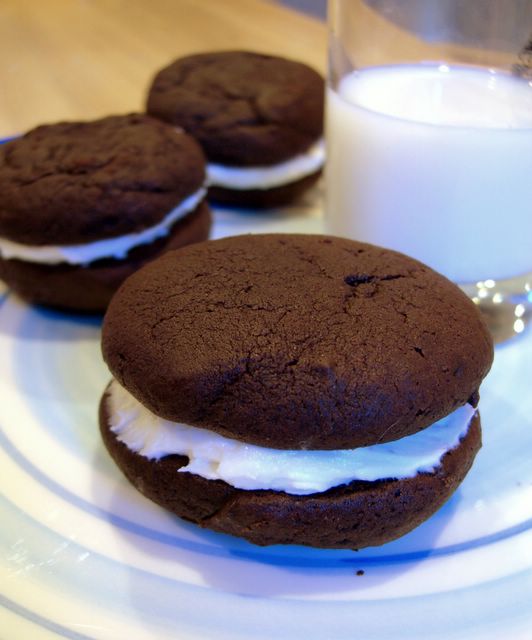
A whoopie pie is a commonly found treat in New England, but is relatively unknown elsewhere, especially on the West Coast. The pies are not really pies at all, as you have probably discerned from the photo above, but are two chocolate cookie/cake discs with a vanilla cream filling sandwiched between them. They’re not like sandwich cookies and not like cream filled cupcakes, but are an entity unto themselves. No one can say for certain where the name came from, though the most widely held belief is that they were named after the reaction that they were intended to elicit from people who ate one.

This recipe comes from Tish Boyle’s The Good Cookie (and is also available on Leite’s Culinaria) and I like it because it doesn’t use shortening in the filling. Don’t get me wrong here: I have had some excellent cookie and cake fillings that use shortening and have no objection to using it in general, but the filling here is simply wonderful. It is very fresh tasting, and not at all greasy or heavy, as vegetable shortening-based fillings can occasionally be.

The cookies are moist and soft, with a rich and chocolaty flavor. They are not overly rich to the point where they overwhelm the flavor of the filling. You might feel compelled to eat them with a bit glass of milk, since they have a very nostalgic quality to them. They are a huge hit at parties, with adults and kids alike. The only change I would recommend making is to double the filling if you like a lot of cream in your whoopie pies.

The cookies are soft and keep very well when stored in an airtight container for several days - assuming that they last that long, of course. The two-bite sized cookies are awfully hard to resist.

(more…)

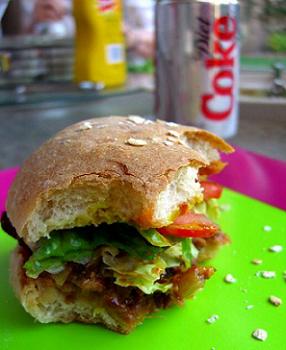
How to make a great hamburger

When I’ve written about making hamburger buns (and hot dog buns)in the past, I generally left out any sort of instructions for making the filling. Basic hamburgers are made with ground beef, which is seasoned and grilled over a relatively high heat, leaving a juicy inside and a patty with very slightly crisp edges.

The timing for grilling hamburgers varies so widely that I won’t even offer suggestions as to how long you should cook you meat, but I will share a few tips on how to ensure that your burger is flavorful and juicy.

(more…)

French Toast Waffles

Pancakes, french toast, waffles… sometimes it seems that breakfast options are so limited. This is, of course, a ridiculous notion that only exists because I tend to make the same basic recipes repeatedly. After all, it’s hard to go wrong with buttermilk pancakes.

One way to spice up breakfast is by adding new spice combinations and fruits, but another way is to think a little bit outside the box. Here, I used my waffle iron to make french toast.

I took a loaf of brioche, soaked each slice in a milk and egg mixture, then put them into the waffle iron to cook, which took same amount of time as a regular waffle. After cooking, the toast turned out to be slightly crispy and waffle-like on one side, and a bit softer on the other, due to the fact that there was slightly more upward pressure on the toast than downward (I didn’t press the lid of the waffle iron down). Not surprisingly, it tasted like a waffle and french toast fused together.

You can’t use just any waffle iron for these. A Belgian waffle iron is likely to tear the bread unless you are making a very, very thick slice of french toast. I recommend sticking to a standard (shallower) iron for these. You can also simply cook the french toast on a griddle on top of the stove if you don’t care to use a waffle iron.

(more…)

Plum Jam

When I heard that the theme of this month’s Sugar High Friday event, hosted by Delicious Days, was to make jam, jelly or some other type of preserves with fresh summer fruits, I was momentarily disappointed. I love jam, but I don’t love the huge amount of work that goes into making it, and I certainly had no intention of standing around and sterilizing jars in 100F+ weather when I can buy perfectly good jams.

Then I saw the blackberry jam post on Meathenge and realized that I didn’t have to go through that whole procedure. I could make a single batch of jam, about enough for a jar full, and would not have to think twice about whether my jars were the right type.

This got me excited again, and I started to mull over my fruit options. My mind was made up when I saw some lovely plums at the market.

My jam is very simple. Plums have quite a bit of natural pectin - the stuff that makes jam and other preserves gel - so I did not have to add any. The fruit was sweet to begin with, so I added only a minimal amount of sugar and a touch of vanilla. The one thing that you do need is a candy thermometer because you must cook the jam until it gets up to just about 220 degrees - any higher than that and it will scorch, but if you don’t cook it enough it won’t thicken properly. The jam tastes great and - really - is very easy. I like the single batch size so I can use it up and switch to another flavor when I run out, rather than having a dozen jars of the same kind in my cabinet.

(more…)

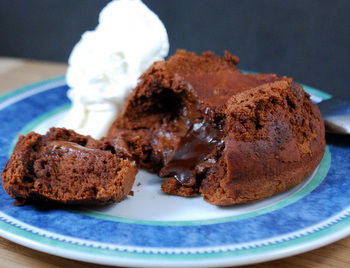
Molten Center Chocolate Cakes

One way to make a molten center chocolate cake is to undercook your batter, preferably at a high temperature that will cause the outside of you cake to appear to be cooked. I don’t honestly think that this is the best way to make a dessert because while cake batter is tasty, I don’t want it for my dessert. I mentioned once before that I was taught to make molten center chocolate cakes by putting a ball of ganache into the center of the cake (or of a souffle) before baking. Once the individual cake is done, the ganache is melted and makes a lovely, warm center when the cake is served.

The trick of using a ball of ganache can really be done with most cupcakes or souffles, and is not specific to this recipe, so don’t be afraid to try it out with your favorite chocolate cupcakes sometime.

This recipe, from Williams-Sonoma, has a fairly light cake that is somewhere between a sponge cake and a souffle, though it is much more chocolaty than those two types of cake usually are. The base is formed and a ganache ball is inserted. It’s very simple.

Once of the best things about this technique is that it is easy to add different flavorings. You can use mint truffles, for example, or even store-bought truffles, provided that they do not have a hard chocolate coating. A chocolate coating should not affect the outcome, but it’s rather like adding ganache and chocolate chips, instead of just ganache.

Whipped cream is the best serving option because the light cream contrasts with the richness of the cake beautifully, though you can’t go wrong with vanilla ice cream, either.

(more…)

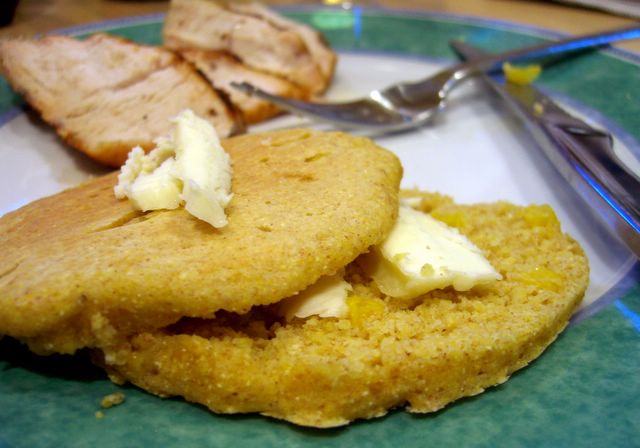
Cornbread Griddle Cakes

A griddle cake is another word for a pancake, but it seems to be used more often to indicate something more rustic and less breakfast-y than the word “pancake.” This makes it the perfect descriptor for these cornbread cakes.

Essentially, these griddle cakes are cornbread that is cooked in rounds on the stovetop, like pancakes, rather than being baked in the oven. The result is something that takes less time than baking, heats up the kitchen less and already comes in neat, individual servings. The cakes have a nice wholesome taste and a good texture, which is a bit “rustic” from the cornmeal, with a lovely little bit of crunch. They are not dense or heavy, but they are very satisfying.

I personally like them best with jam, but one of the best things about them is that they are incredibly versatile. The cakes can be topped with everything from butter to salsa, used to mop up barbecue sauce or gravy or even served with maple syrup.

I used some fresh corn in the griddle cakes, but you can also add other things to them, such as cayenne pepper and lime zest for a spicier variation, or some chopped up pre-cooked bacon, for something really savory.

(more…)