Archive for: dark chocolate

Semisweet chocolate chips are a standard ingredient in most bakers’ kitchens. They are the standard for baking chocolate chip cookies, one of the most popular homemade treats out there, as well as for many other baking applications. Semisweet chocolate is typically labeled as just that: semisweet chocolate. But as chocolate labeling gets more and more specific and consumers start to identify with cacao percentages rather than just names, that brings up the question of what exactly semisweet chocolate is.
Semisweet chocolate is dark chocolate, meaning that it is made with cocoa solids (cocoa butter and cocoa solids) and sugar, and typically includes vanilla and an emulsifier. There is no exact amount of sugar required to be called “semisweet,” but the name generally indicates that no more than 50% of the mass of the chocolate is sugar. This is opposed to “sweet” chocolates, where more than 50% of the mass of the product is sugar. “Sweet” chocolate is a pretty old fashioned term these days and only appears with a handful of products, such as German’s Sweet Chocolate.
The range of sweetness in semisweet chocolates is huge. Some brands are much sweeter than others, while some are much smoother. The same could be said of most dark chocolates. The thing that makes semisweet chocolate special is that it has a good balance of chocolate and sweetness that makes it exceptionally versatile and able to work well in just about all recipes, while milk chocolate can be too sweet and a very dark chocolate can overwhelm the more subtle flavors in a recipe.

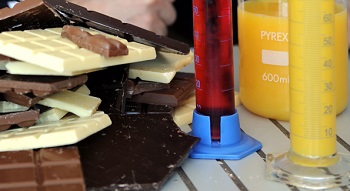
Tempered chocolate is very glossy, has a firm finish and melts smoothly at around body temperature. Simply melting the chocolate before you use it to dip berries, truffles or other goodies does not temper it. The process of tempering involves raising and lowering the temperature of the chocolate to encourage strong, organized crystallization of the cocoa butter so that the finished chocolate will have that glossy look, a sharp snap and will be resistant to chocolate bloom. In short, tempering chocolate makes it last longer and look better, and if you are serious about using chocolate in your kitchen, it is good to know how to do it.
There are several ways to temper chocolate and this method is known as seeding. It is very simple and it is very easy to do at home, both with small and large quantities of chocolate. For this demonstration, I am working with dark chocolate. Milk and white chocolates also need to be tempered and can be tempered in the exact same way as this dark chocolate, but the tempering process happens at a slightly lower temperature.

+Continue Reading

Semisweet chocolate chips are the default mix-in for most chocolate chip cookie recipes. Over the past several years, consumers have seen a huge increase in the variety of chocolate chips (and chocolate chunks) available at the grocery store as options for baking. One question I get asked frequently is whether it is ok to substitute one type of chocolate chips for another, and what difference it will make in the final recipe.
The short answer is that it is perfectly fine to substitute one type of chocolate chips for another in a recipe that calls for them. This is true for cookies, cakes, brownies and other recipes that call for mixing-in a quantity of chocolate chips. Most recipes call for semisweet chocolate by default, as those are still the most common type of chocolate chip, but some will make recommendations for milk or dark chocolate chips based on what the recipe author thinks tastes best in that recipe.
All chocolate is made up of cocoa solids – cocoa butter and cocoa powder – and typically includes sugar, an emulsifier and vanilla. Milk chocolate has milk solids added to it as well, while dark chocolate does not. Semisweet chocolate is not strictly defined (there is no exact amount of sugar to be called “semisweet”, though it generally means no more than 50% of the mass of the chocolate is sugar as opposed to “sweet” chocolates, where there is even more sugar) but it is essentially dark chocolate because it does not contain milk solids. Semisweet chocolates are not typically very sweet, but they are sweeter, not as intensely flavored and lack the bitter notes that some “ultra-dark” chocolates have. Semisweet chocolate gives a balanced flavor to most chocolate chip cookie recipes, adding just the right amount of sweetness and chocolate flavor. A darker chocolate, with more bitter cocoa notes than semisweet, will have a stronger presence in a cookie or cake and may overwhelm some of the subtle flavors in that recipe. Milk chocolate is typically much sweeter than either of these and can actually taste too sweet in a cookie or cake, as it does not add enough contrasting chocolate flavor.

When you think of Nestle Toll House, you probably think of their chocolate chips and classic chocolate chip cookies. The company makes a wide variety of chocolate chips, including seasonal Mint Chocolate Chips and fancy-looking Peanut Butter Swirled Chips. Due to the ever-increasing popularity of dark chocolate (and to more consumers interested in quality chocolate), Dark Chocolate Morsels with 53% cacao content were introduced to the Toll House family. They’ve followed this up with a Nestle Toll House Dark Chocolate Baking Bar.
The baking bar is made with 62% cacao and, while its wrapping matches the signature chocolate chips of the brand, it has the exact same ingredient list as many higher end chocolates. The bar is relatively thin and is divided into eight half-ounce squares that break up easily when you need a portion of the bar for a recipe. The chocolate itself is very smooth, with fruity notes and a rich cocoa flavor. It is slightly sweeter and has fewer bitter notes than some similar dark chocolates, but it is definitely a tasty bar and worth eating on its own as well as using in a recipe.
This chocolate bar can be used in most recipes that call for dark chocolate, including chocolate mousses and chocolate puddings, as well as cookies, brownies and cakes that use dark chocolate. The thin bar chops up easily and melts down quickly. If you prefer, you can even cut it into chunks and add them to your chocolate chip cookies, though you might want to stick with the dark chocolate chips for convenience (and price, since this bar is only 4-oz and you would need a couple to replace the chips in most chocolate chip cookie recipes) and save the bar for other occasions.


When you have a serious chocolate craving, not just any chocolate cupcake is going to fit the bill. A batch of these Dark Chocolate Cupcakes is what you need when that kind of craving strikes. These cupcakes remind me of brownies, with their intense dark chocolate flavor. They also develop a slightly crackly top during baking, like brownies. Unlike brownies, the cupcakes are not dense and fudgy. They have a very tight and tender crumb that almost seems to melt in your mouth when you take a bite.
This is definitely a go-to recipe when I’m looking for a really rich chocolate cupcake. The flavor comes from a generous amount of dark chocolate that has been melted into the batter. I typically use a dark chocolate that is around 70 or 72% cacao, but the recipe will still work with a slightly more or less dark chocolate. You’ll get a lot of chocolate flavor in the cupcakes, so be sure to use a good quality chocolate in this recipe.
These cupcakes are very versatile and can be topped off with any kind of frosting you like. Instead of sticking with chocolate or vanilla, I opted for a more fall-flavored pumpkin frosting here. Pumpkin puree by itself doesn’t necessarily have that strong of a pumpkin flavor (not strong enough that a small amount will be enough for a whole batch of frosting), so simply adding pumpkin puree to a buttercream wasn’t going to produce the flavor that I was looking for. Pumpkin puree can be a bit coarse, as well, and needs to be processed very finely or pushed through a sieve to get a silky texture. Pumpkin butter – a very smooth, sweet and intensely flavored pumpkin preserve – was the answer to my flavoring problem. A small amount of pumpkin butter packs a lot of pumpkin flavor and was the perfect way to introduce a pumpkin element to an otherwise vanilla frosting. Pumpkin butter is available at many stores around Halloween and Thanksgiving, and you can always make your own. If you can’t find it, you can use pumpkin puree that has been strained, but you will also want to add a bit of extra spice to your frosting for extra fall flavor.

+Continue Reading