I’ve really been enjoying working with my new Blendtec Designer Series Blender, as it is a cut above the blenders that I’ve used before and is good for a lot more than just mixing up fruit smoothies. The people at Blendtec were kind enough to provide an extra Blendtec Blender for me to giveaway to one lucky reader, so now is your chance to put your entry in for a chance to win!
+Continue Reading

A blender is an appliance that a lot of us have, but that a lot of us take for granted. Most of the time, it is used for making drinks and smoothies, although it can be used to puree just about anything and can actually take on many of the functions of a food processor. I know that I never used any of my blenders to their full potential and it was only when I started making Blender Waffle Batter on a regular basis that I started to see how great a blender could be. When my last blender bit the dust, I waited quite a while before replacing it because I wanted to make sure that I got a good one. The Blendtec Designer Series Blender was on my short list because I knew it was a powerful machine and I figured that it was time for an upgrade, even though my blending isn’t as intense as the hilarious and fun Will it Blend? video series that Blendtec puts out, but before I could make the final purchase, Blendtec actually offered me a blender to test out and review. And I have to say that it just might be the best blender I’ve ever had.
+Continue Reading

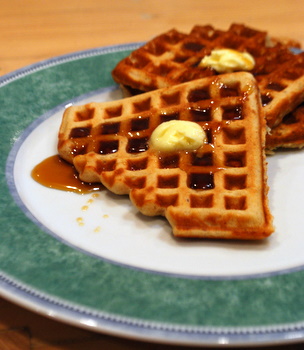
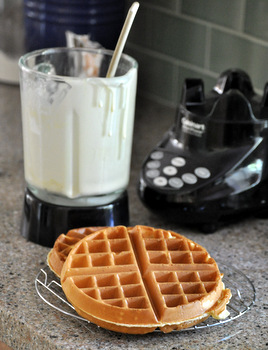
One of my favorite waffle recipes is my recipe for Blender Waffles. The batter for them is made entirely in the blender, so it takes almost no time to put together – and you can pour it easily straight from the blender onto your waffle iron with no mess. These Honey Whole Wheat Waffles are a variation on this basic recipe that is a little bit healthier than the classic recipe, but just as tasty. The waffles are light, with a hint of butter and honey to them that makes them almost sweet enough that you can skip the syrup and eat them plain, hot out of the waffle iron.
The waffle batter uses white whole wheat flour in it, instead of regular all purpose flour. This gives you a good dose of whole grain in your waffles. I prefer the white whole wheat over regular whole wheat flour because it still gives you a nutty whole grain flavor, but keeps the waffles light and fluffy. Regular whole wheat flour can make waffles a little bit dense, so if you don’t have white whole wheat flour, I would cut regular whole wheat with a little bit (25-30%) of all purpose flour to keep the waffles light and tender.
I sometimes add a little bit of ground flaxseed to these waffles to give them a little nutritional edge, but you can skip that if you don’t have any on hand. You can also add a little bit more, if you are a fan of flax. And, if you don’t have a blender, you can make this batter in the food processor or with a whisk and a large bowl – but the blender will really help fluff up the batter and give you a great, easy finished product. Any way you make them, serve them with honey, maple syrup and a touch of butter.
The waffles can be made in a traditional waffle iron or a deep Belgian-style iron. The recipe can also be doubled to serve a crowd. Leftover waffles can be cooled to room temperature, stacked with pieces of wax or parchment paper and stored in an airtight back in the freezer for future breakfasts, too.
+Continue Reading

I recently lost my regular blender when the motor burned out as I made a batch of iced coffee drinks on a hot weekend afternoon. I had to scrap the blended coffee drinks for the day, of course, but not having a working blender also meant that I wasn’t able to make my favorite blender waffle recipe until it was replaced. I haven’t picked out a new model yet, but luckily for me, a recent Cook’s Illustrated (Sept/Oct 2012) featured a test kitchen review of blenders that is making the process a little easier!
The test kitchen was looking for a blender that could handle any task, from blending milkshakes to margaritas and pureeing soups to smoothies. They wanted something with a lot of power, durability and that made less noise than a jet engine. They also looked for a blender that was a consistent performer, blending smoothly and not leaving chunks of unblended food trapped beneath its blades.
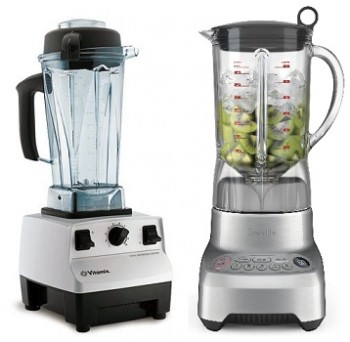
The two top performers, and co-winners, were the Vitamix 5200 and the Breville Hemisphere Control Blender. The Vitamix has the steepest price, but has exceptional strength and durability. The Breville costs less than half of what the Vitamix does, and performed admirably at every task it was challenged with. The test kitchen also noted that if the Breville holds up to their prolonged use in the test kitchen as well as it did to their durability tests, it might end up being their top overall blender in the future. It is going to the top of my list of blender choices at the moment, too!
Runners up, receiving the “Recommended with Reservations” designation, were the Ninja Professional Blender and the Hamilton Beach Rio Commercial Bar Blender. The Ninja didn’t quite crush ice as well as the winning blenders, and the Hamilton Beach sometimes trapped ice cubes and fruit beneath its blades and needed a little encouragement from a spatula to finish the job.
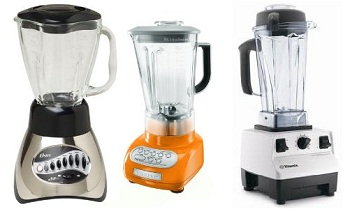
The “Not Recommended” blenders included the Cuisinart Blend and Cook Soup Maker, Hamilton Beach Wave Maker, Oster 7-Speed Blender and the Waring Pro Professional Food and Beverage Blender. I also want to point out that the test kitchen’s previous favorite model, the KitchenAid 5-speed Blender, was dropped completely from their testing and didn’t even make the “not recommended” list because it showed signs of falling apart during the test.

An immersion blender is a handheld kitchen appliance that allows you to blend or puree foods in the container that you are preparing them in. For instance, you can puree a soup directly in the pot you’re cooking it it, rather than transferring it in small batches to a food processor or blender to puree. You can use an immersion blender to blend a one-person smoothie or milkshake directly into your cup, as well as to make smooth sauces, well-emulsified dressings and purees. An immersion blender looks like a long, thick stick. The top portion serves as the handle and the controls for the device. The base of the mixer is an attachment with a small blade at the end. This piece either snaps on or screws on (depending on what brand/model of blender you have) and this is the piece that goes into your soup, etc. to do the hard work of pureeing. It is removable to make cleaning up an easy task, and most immersion blender attachments are dishwasher safe. To use it, simply insert the blade end into whatever you’re pureeing and turn the blender on (some have multiple speeds, other models only have one). By simply stirring the blender around, you’ll have a very smooth puree in very little time.
In addition to the blade blender attachment, immersion blenders – also known as stick blenders – can come with other accessories, such as whisk attachments and chopping attachments. A whisk works in largely the same way as a handheld mixer, though it is not as strong as a handheld mixer and is much better suited to whisking eggs, whipped cream or dishes on the stove (such as custards or puddings) than for mixing up a cookie dough batter. The chopping attachment, which includes a small container, makes quick work of chopping small amounts of vegetables for salsas and is definitely a favorite tool for many immersion blender users.