Archive for the ‘Candies’ Category

Candied Lemon Peel

Candied Lemon Peel

Candied citrus peels have a lot of flavor in a little, sugary package and they’re a lovely treat to make after you’ve just juiced a lot of citrus fruit because they make good use of all those orange and lemon rinds. You can candy any kind of citrus fruit, but one of my favorites is lemon because it has a bright flavor and goes well with all kinds of recipes.

I use a paring knife to cut the skin off of the lemon, getting only a small amount of the pith (the white part beneath the skin) and try to keep the peels at a uniform thickness, even if they are unevenly shaped. I then cut each large strip into several smaller strips before candying. Candied orange peels are typically cut into uniform strips and are often served as a candy in their own right. I rarely see this with candied lemon peel. And while I like to snack on them when I make them, I don’t typically serve them on their own,  either. As a result, I am a lot more casual about slicing my peels before candying. There is a lot of variation in the size and shape of my candied lemon peels, though I try to keep the thickness uniform, and they turn out just fine.

Once your peels are cut, the next step in candying lemon peels is to blanch the rind to remove any bitterness. Some recipes advise you to do this up to three times, changing the water and blanching again. I tend to only do this step once. I use organic lemons and meyer lemons and don’t find them to be too bitter, even with a small amount of pith still on the rind. So, I feel that this is a matter of personal preference and you can blanch your rinds up to two more times if you prefer when you try this recipe at home.

The peels are then cooked in a sugar syrup until they are tender and well-infused with sugar. The peels are dried, then rolled in more sugar to give them a crisp finish. The peels store very well and, once they are completely dry, they can be stored in an airtight container for up to several weeks. They can also be incorporated into other recipes or used as a garnish for desserts.

And don’t forget to save the leftover sugar syrup when making this recipe. It is very sweet and has a terrific lemon flavor, so it can be used to sweeten drinks or make a big batch of lemonade!

+Continue Reading

Chocolate Mendiants

Chocolate Mendiants
Once you have mastered the process of tempering chocolate, you are going to want to be able to do something with all of it. One of the simplest options for your tempered chocolate is using it to dip strawberries, homemade marshmallows or other goodies that you already have around the house that could use a layer of chocolate. The next simplest option is to make Chocolate Mendiants.  Mendiants are a traditional French confection made with a disc of chocolate topped with dried fruits and nuts. They’re typically very colorful and they are so versatile that they never get boring.

Mendiants can be made with white, milk or dark chocolate and any combination of topping elements. Whole nuts, such as almonds and hazelnuts, are traditionally the “anchor” of a mendiant and other nuts and dried fruits are added for color and flavor. The key to a good mendiant is to experiment with flavors that you like, but to try to chose combinations that look as good as they taste so that the candies are visually appealing, too. Whole

You can customize the treats to your own tastes, but you’ll get the best results by mixing up a variety of colors, flavors and textures.  For a little inspiration, a few of my favorite combinations include:

  • Almonds, pistachios and dried apricots
  • Almonds, pistachios and cacao nibs (pictured)
  • Walnuts, pistachios and cranberries
  • Pecans, cherries and gingersnap cookie pieces
  • Macadamia nuts, dried pineapple and coconut shreds

You will want to line your work surface with parchment paper so that it is easy to move your mendiants after they have set up. I prefer to put my parchment on baking sheets, so that the mendiants are easy to move around if I need more space, but you can just as easily place the parchment sheets on a table or countertop. Make sure that your toppings are close by; the chocolate sets up quickly once it is piped and you want those toppings to be easy to reach for! I recommend piping a few circles of chocolate at a time, then adding the toppings before piping another row. The chocolate will spread slightly, but you can put these fairly close together and fit a lot of chocolates onto one sheet of parchment.

+Continue Reading

Homemade Sea Salt Caramels

Homemade Sea Salt Caramels
Salted caramels are one of the most addictive snacks out there. Adding salt to sweet, buttery caramels creates just the right balance between sweet and salty and makes your mouth water (in a good way!) while eating them. I often buy these treats when I see them at stores, but it is not too difficult to make sea salt-topped caramels at home – and having a good from-scratch recipe means that you can have them any time you want! These Homemade Sea Salt Caramels are buttery caramels that are topped with a generous sprinkling of coarse sea salt. These are soft and chewy, with a nice balance of sweetness and salt. You will want a candy thermometer to ensure that you get good results, but this is a relatively easy homemade candy recipe that is definitely worth trying.

There is a small amount of salt in the caramels to flavor them, but I saved the sea salt in these caramels for the topping. Although some sea salt caramels will use sea salt in the caramel itself, I found that I didn’t notice a real flavor difference when I used the sea salt in the recipe. There is, however, a huge difference between putting table salt and coarse or flaky sea salt on top of these and it is worth getting the good stuff! Any coarse sea salt that you like will work well. I personally recommend flaky Maldon Sea Salt, which has a great flavor, excellent texture and a beautiful look.

Once the caramel is prepared, you can pour it into a 9×9 glass or pyrex baking dish. The 9×9 makes caramels of a nice thickness, but if you want to make your caramels smaller (or just make a lot more of them), you can also use a 9×13 pan and get thinner caramels. Do not forget to grease the pan with butter (or vegetable oil, though I recommend butter here) before adding the caramel! The first caramel may get slightly squished when you pry it out of the pan, but the caramels generally come out easily if you remove them immediately after slicing. Use a very sharp, warm (run under hot water and dried) knife for best results.

Homemade Sea Salt Caramels

+Continue Reading

Caramel-Dipped Pears

Caramel Pears
You will see all kinds of fruit dipped in chocolate, from delicate berries to large stone fruit. When it comes to caramel dipped fruits, however, apples are just about the only ones that you see. Sweet-tart apples are a great match for caramel and the fruit is sturdy enough to hold up to being dipped into relatively hot caramel (chocolate melts at body temperature, so is much cooler when things are dipped into it compared to caramel), but apples aren’t the only fruit that can be dipped in caramel and I have recently discovered that Caramel-Dipped Pears can be a wonderful treat, too.

To make these, I first prepared a batch of the same salted caramel that I used when making my Classic Caramel Apples and then dipped not-quite-ripe pears into it, holding the pears by their stems. Pears don’t take as well to having chopsticks inserted into them as apples do. Fortunately, when the pears are not yet at their peak of ripeness, it is easy to handle them simply by holding on to the stems. Ideally, the pears that you use for dipping should only have a very slight give to them if you give them a gentle squeeze with your fingertips.

It is important to use a pear that isn’t quite ripe yet for several reasons. First, the pears are sturdier and will hold up to both the dipping process and the warmth of the caramel. A pear that is already extremely ripe and soft may break apart when dipped into the caramel, or the skin might tear. Second, using slightly unripe pears allows you to dip your pears well ahead of time. The pears will continue to ripen after being dipped (since pears generally ripen off their trees), so you can dip them one day and have a perfectly tender, ripe pear that is enrobed in caramel and ready to eat a couple of days later. If you really want your pears to last, you can store them in the fridge, where they will ripen even more slowly than pears at room temperature.

I used Comice pears – Royal Riviera Pears from Harry & David, to be specific – because they are my favorite type of pear. Sweet and juicy, they have a sturdy flesh and are large enough that you get a great ratio of caramel to pear. These pears also become extremely tender when they are ripe, providing a great contrast to the chewy caramel. You can use other types of pears, too. Bosc pears are a great choice and have a nice firm flesh that makes them a popular choice for poaching and baking. Anjou and Bartlett pears, providing they have stems long enough to grasp when dipping them, can be good choices, too.
+Continue Reading

Classic Caramel Apples

Classic Caramel Apples
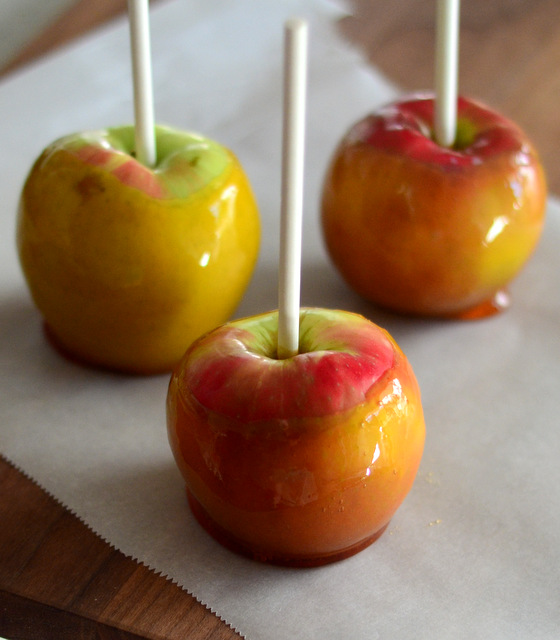
It is almost impossible to resist a good caramel apple. Not only are they stunning to look at, but the combination of slightly salty, buttery caramel with sweet-tart juicy apples is pretty close to perfect. I’ve worked on making a good caramel apple recipe for a long time. It is tempting just to use store bought caramels (good quality, of course!) because they are very convenient and melt down in just a few seconds in the microwave. It is much more satisfying – not to mention tastier – to make your own Caramel Apples from scratch.

To make the apples, start by cooking sugar, water and a small amount of corn syrup (golden syrup is a good substitute if you don’t have corn syrup) together in a large saucepan until it turns dark golden in color, then you stir in heavy cream, butter and salt. I usually cook the first portion of this recipe without a candy thermometer, because it is very easy to see the color of the sugar turning a deep gold. Once the cream and butter have been added, the caramel needs to cook until it reaches hard ball stage (260F) so that it will be thick enough to stick to the apples without simply running down the sides of the fruit. You will need a candy thermometer at this point to ensure that you get accurate results. The caramel making process is not difficult, it just requires a little bit of patience.

When you’re making caramel apples, you can really use almost any kind of apple that you like. Some people really like tart Granny Smith apples as a contrast to the caramel. Others prefer a sweet apple, any kind that they would normally choose for a snack. I tend to use the same types of apples that make good choices for apple pie, apples that are crisp have a bright flavor, like Braeburn, Fuji and Pink Lady apples. I also like the look of a red apple underneath all that caramel, so I definitely go out of my way to choose particularly good looking apples when I’m ready to make a batch of these!

Once the apples are dipped, place them on a silpat or a piece of parchment paper to set up and they will be easy to peel off once the caramel has cooled. This recipe makes enough caramel to cover 6 large apples. You can double it (be sure to use a much larger saucepan!) if you want to make more, though I would recruit an assistant to help with dipping if you’re going to make that many. They will keep well for several days, but should be kept in a cool, dry place if you’re not going to indulge right away.

+Continue Reading