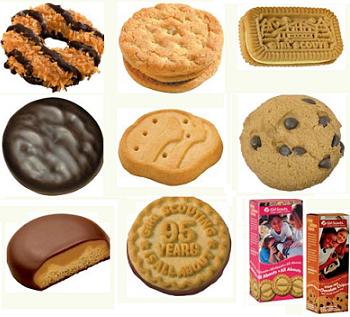
If I were to meet them in person, I would give Girl Scouts Rhiannon Tomtishen and Madison Vorva each a big batch of my homemade Girl Scout cookies because they are trying to change the way that the Girl Scout organization bakes their iconic Girl Scout cookies. These two girls set to work on a project to raise awareness of endangered orangutans and how their habitats are being destroyed. They discovered that much of that land was being cleared to make way for palm oil plantations. Palm oil is used in many different foods as a non-hydrogenated fat, but the one that stood out the most to these two girls is that palm oil was used to make Girl Scout cookies. It was a surprising realization and they decided to shift their campaign away from simply raising awareness and towards removing palm oil (or getting it from only sustainably grown sources) from Girl Scout cookies. Already, members of more than a few scout troops are saying that they no longer want to sell Girl Scout cookies.
Girl Scouts spokespeople say that there is no viable alternative to using palm oil in their cookies because they need them to be “sturdy” and have a long shelf life. Sustainably grown palm oil is simply too expensive and there isn’t enough of it to meet their demand. The bakeries began to make the switch to using palm oil from partially hydrogenated oils in 2006, after coming under fire for having trans fats in their baked goods.
+Continue Reading

Homemade cookies are always the best in my book, but because I was a girl scout when I was little, I have a soft spot for girl scout cookies. Actually, I used to have a soft spot for girl scout cookes. Given that the cookies increase in price every year without an increase (and sometimes with a decrease!) in quality, it’s hard to keep standing behind them, even when they’re just a seasonal item.
One issue is trans fats. The cookies are made by two bakeries, both of which have cut down on the amount of trans fats in their cookies. The cookies still have a trace amount of trans fats because the bakeries both still use partially hydrogenated vegetable shortening in their recipes. One of the bakeries has put out an informational flyer (here, as a pdf) trying to explain why they use partially hydrogenated shortening – gallingly comparing it to cooking with regular vegetable oil, which certainly wouldn’t produce the same results when used in baking, when butter and non-hydrodenated shortening are both readily available substitutes.
A note to the Little Brownie Bakers bakery: despite what you claim in your flyer, butter is not a hydrogenated product, and is not the same thing as partially hydrogenated vegetable shortening. At least ABC has their facts straight.
Back to the cookies, if you’re going to be buying any this year, you’ll be pleased to see that the classic flavors are around – Thin mints, Samoas, Trefoils, Tagalongs, Do-Si-Dos – as well as some of the newer flavors introduced in the past few years. There are three new flavors, including two “healthy” options: a 100 calorie pack cinnamon cookie (Cinna-Spins) and Sugar-free Chocolate Chip cookies. The third “new” flavor – Lemon Chalet Cremes – is a cream-filled cookie that seems to pop up every couple of years with a slightly different name. The twist on the cookie this year is the fact that it has a “hint of cinnamon-ginger spice” to it.
I honestly don’t know yet if I’ll buy any Girl Scout cookies this year. If I want to support a local troop, I might just make a donation and stick with homemade versions of the cookies, like Homemade Thin Minties or Homemade Samoas.