Every year at Thanksgiving, the seemingly age-old debate arises as to what exactly constitutes stuffing and what constitutes dressing. Both “stuffing” and “dressing” are terms applied to the traditional Thanksgiving side dish of a most, seasoned bread (or other starch, like rice of potatoes) and vegetable mixture. It is either cooked inside the turkey or alongside the bird, and your preferred term for the dish – as well as the way you cook it – is probably a result of where you grew up. I’ve heard that dressing is a more popular term in the South, while stuffing – both the term and the actual act of stuffing a turkey – are more popular in Northern states.
Broadly defined, dressing is a sauce or other mixture used to flavor salads and meats. With this definition, stuffing that is cooked inside of a turkey and stuffing that is cooked outside of one would both be dressings, while actual stuffings are simply a subset of the larger category.
That being said, I will continue to call all of my dressings “stuffing” because that is the term I used growing up and I’m used to it. I bake them outside of the turkey to get a crispy crust and a moist interior, whether I am using cornbread as a base, mixing in caramelized onions or keeping the whole dish vegetarian.
Do you prefer the term stuffing or dressing? How do you prepare your version of this dish?

Stuffing – also known as dressing, depending on what part of the country you’re from and what your family traditions are – is a traditional Thanksgiving side dish made with bread and seasoned with spices and vegetables, either baked inside the turkey or cooked on the side. I am a firm believer that stuffing should have both a simple ingredient list and a crispy top – and in light of that latter restriction, it’s probably obvious I prefer stuffing cooked outside of a turkey. The contrast between a moist interior and a toasted, oven-browned topping is pretty much what makes stuffing worth having at the dinner table.
In the past, I’ve made vegetarian stuffing and maple cornbread stuffing. This year, inspired by the french onion soup I recently made, I opted to make caramelized onions the centerpiece of my stuffing. It doesn’t take too much time to caramelize the onions, and once they’re done and the celery has been briefly sauteed, everything can be mixed together and put into the baking dish until it’s ready to be put in the oven. I generally make the stuffing up either the night before I’m going to bake it or while the turkey is in the oven, then I just slide it in to the preheated oven while the turkey is resting and being sliced.
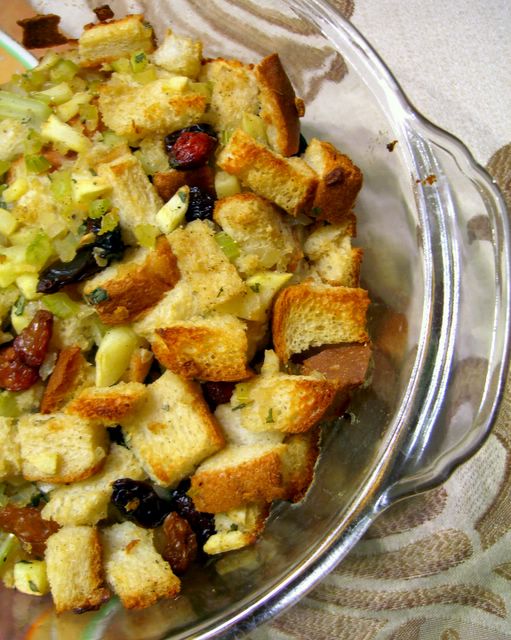
You can use just about any kind of bread for this stuffing recipe. I like a plain, sandwich type of bread because it provides the cleanest slate for the flavors of the onion. Whole grain or multi grain breads will work well too, although I wouldn’t choose a bread with a very thick “rustic” crust (those tend to be better on their own and make the stuffing less uniform).
+Continue Reading

There are some schools of thought that say you shouldn’t use the same kind of cornbread that you like to eat plain when you are making a cornbread stuffing. They suggest using denser or sturdier cornbread that won’t break or crumble when mixed in, but will hold its shape just like bread cubes do. My feeling is that if your cornbread is good when eaten on its own, it will make great stuffing even if the cornbread cubes crumble a bit when you go to mix them up with the rest of the stuffing ingredients. With this in mind, I used part of a batch of Maple Cornbread to make some sweet and savory stuffing.
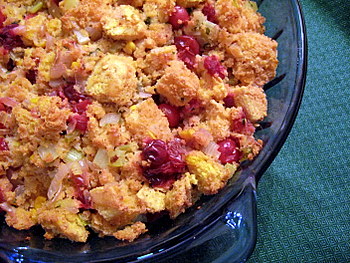
This stuffing is the type that is baked alongside a turkey, rather than being stuffed inside of one. It has a soft and most interior and a lovely crispy crust on top. The flavor of the stuffing is a little unusual for a couple of reasons. The fact that cornbread is used gives it a lot of flavor and texture, but putting that aside, the most interesting elements here are the fresh cranberries. Cooked slightly before being mixed in, the berries are juicy and tart – not common flavorings in stuffing. The mixture also has red pepper flakes for heat, cumin for some smokiness, maple syrup, and a mixture of celery and onions.
Sausage is an optional element here. You can add in some sausage (I recommend something slightly spicy) when you are sauteing the celery and onions, but you can also easily omit it to make the stuffing completely vegetarian. With the sausage, the stuffing is really a meal on its own, so it might be best to keep it veg if you’re planning on using it as a side dish during an already big holiday meal.
My final note on this stuffing is that it can be prepared a day in advance and baked just before serving. Once the ingredients are mixed and placed in your baking dish, cover with aluminum foil and refrigerate for up to 24 hours before baking. The stuffing can also be reheated in a 375 oven – covered if you like yours soft and open if you like yours crunchy – for about 20 minutes.
+Continue Reading

Whether you call it stuffing or dressing, this dish and its many variations are a classic holiday dinner side dish. Personally, I always called it stuffing, regardless of the fact that it may or may not have actually be stuffed in a bird. I don’t really care for the mushy texture of the in-bird stuffings, so I tend to opt for the “on the side” variety with a crunchy, browned top.
I was working on a couple batches of stuffing for Slashfood this week and I really like the recipe that I ended up with, so I figured I’d share it here as well as there. This version uses cranberries instead of raisins and eliminates the small amunt of oil, which I found made little difference in the crispness of the final stuffing.
It’s very easy to make and completely vegetarian. It is flavorful with sage and a fair amount of sweetness from the fruit. You can, of course, adjust the seasonings to suit your tastes and the type of bread you are using. I don’t usually measure things as I’m adding them (and will sometimes toss in a bit of paprika or garlic just to make things different), so these are ballpark figures anyway. I like to use fresh bread, not stale, since the flavor is better and it gets just as crispy on top in the oven. I also like to use a good-qualiy store bought bread (usually from TJs or something) rather than homemade, since I tend to want to eat homemade breads and not chop them up into stuffing.
The only “odd” thing about the recipe is that I noted you should use “strong” vegetable stock/broth for the best flavor. I use a vegetarian bullion to make my veg stock, so it is easy to increase the amount for a stronger batch. Add a tbsp of soy sauce to boost the flavor if yours isn’t particularly flavorful.
+Continue Reading