Archive for: shortbread

Lime and Cranberry Thumbprint Cookies

Lime and Cranberry Thumbprints
Tart and tangy cranberries are often pared with oranges and orange juice, but cranberries actually go very well with all kinds of citrus. I like cranberries with lemon in cakes and quickbreads, for instance, and lime might be an even better match for them. Limes have a bold, tart flavor that is similar to that of cranberries, and as long as you balance the sugar out so that your finished product isn’t overly tart, you will get a combination that is a winner no matter what you are baking.

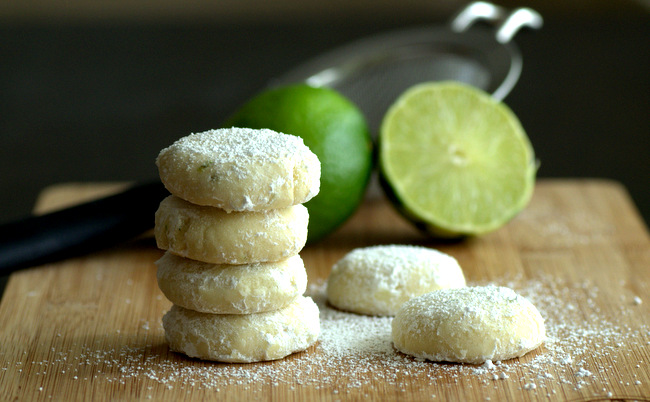
These Lime and Cranberry Thumbprint Cookies have a great balance of lime and cranberry in a very pretty cookie that is a festive addition to any dessert plate. The cookies start out with a shortbread-type cookie dough that is flavored with lime zest and vanilla. There is no leavening in the dough because you need the cookies to hold their shape during baking, after you make “thumbprints” to fill with cranberry sauce. You can use just about any cranberry sauce for this recipe (I usually use a homemade sauce) as long as it has chunks of real fruit in it. Cranberry jelly, which is more like jello, is not ideal for this recipe.

The cookies are tender and buttery, with a good lime flavor and a bright burst of cranberry in the center. They’re a little bit soft, rather than crispy, which is nice with the cranberry sauce center.

I typically make the thumbprint marks for these cookies by using my finger, dipping it in a little bit of flour in case it gets sticky while I’m working. You can also use the end of a large wooden spoon, if you have one that has a round handle on it, or the back of a half or quarter teaspoon measure. I always eyeball the amount of filling, trying to mound it just over the top of the cookie dough around my thumbprint. Don’t worry too much about getting an exact amount of filling in each indent, just fill up the thumbprint you have made – large or small. It’s more important not to go overboard with too much cranberry sauce, because your cookies won’t have a clean look if the filling bubbles over the side of the cookie during baking.
+Continue Reading

Chocolate Shortbread Tart Crust

Chocolate Shortbread Tart Crust
I love a buttery shortbread crust on a tart and it is a go-to for many of my favorite tart recipes. There are some tarts, however, that do a bit better when there is a little more chocolate involved and for those tarts I use a Chocolate Shortbread Tart Crust as the base. This easy-to-make shortbread is made with cocoa powder, which gives the crust a nice bittersweet chocolate flavor without making the crust too rich or heavy. In fact, the tart crust is crisp and tender, with a nice buttery note to it.

Like many shortbreads, this dough is made by cutting butter into a mixture of dry ingredients. The mixture should be fine and sandy, with the butter cut down to tiny pieces to create a tender shortbread. This can be done by hand, but mixing up the dough in the food processor is faster and easier. The finished dough is crumbly and is simply pressed into the tart pan, rather than being rolled out. This makes tart assembly very easy, especially since the crust doesn’t need any pie weights or special treatment before baking. The crust is a great base for all kinds of tarts. It can be baked completely and filled with pastry cream and fresh fruit, or filled with a rich chocolate ganache. It can also be used for baked tart fillings, and baked along with the filling rather than being prebaked.

+Continue Reading

Pistachio and Dark Chocolate Butter Cookies

Pistachio and Dark Chocolate Slice and Bake Cookies
A melt-in-your-mouth butter cookie is hard to resist. They are even harder to resist when you incorporate other delicious ingredients into the cookie dough, such as chopped up nuts and chocolate. A good example, of course, is this batch of Pistachio and Dark Chocolate Butter Cookies. These are easy to make slice-and-bake-cookies that are studded with crisp pistachios and rich dark chocolate. The fact that they’re a slice-and-bake recipe means that the dough can be made ahead of time and you can slice off and bake as many – or as few – cookies as you need, so they are as convenient as they are tasty.

Pistachios and dark chocolate are a great flavor combination in these cookies. Both flavors stand out very well against the background of not-too-sweet butter cookie dough. The dark chocolate adds a dramatic hint of bitterness to the cookies, while the pistachios actually taste richer and bolder than they do on their own. I used toasted, lightly salted pistachios to introduce a bit of a savory element to these cookies, but balanced it by rolling the edges of the dough in sugar, which lent an extra sweetness and a bit of crunch to the finished cookies.

The cookies are buttery and very tender, with a nice crispness to them. If you prefer your cookies a little crunchier, you can simply leave them in the oven for a few extra minutes.  You can also use other types of nuts – walnuts, pecans or almonds, to name a few – in these cookies and still get good results. I like pistachios primarily because I feel that they work especially well with the dark chocolate. My other motivation was that the green nuts make the finished cookies look very striking. It definitely tempts you into picking one up to see what the combination will taste like for yourself!

+Continue Reading

What is cornstarch?

Cornstarch
Cornstarch is a fine, powdery starch that is made out of corn. The cornstarch is actually made from the endosperm of the corn, which makes up most of the kernels that we eat when enjoying popcorn or corn on the cob. Cornstarch, also sometimes called cornflour, is produced by grinding, washing and drying the endosperm of the corn until it reaches that fine, powdery state. Cornstarch is gluten free.

Cornstarch has many culinary uses, but it is most often used as a thickener for sauces, gravies and fruit pie fillings. Cornstarch thickens very quickly and easily, and forms a clear sauce after cooking, rather than an opaque one. It has roughly twice the thickening power of flour, and while it is flavorless after cooking, it does need to be cooked for a short period to remove any starchy flavor from the starch, as well as to give the mixture it is used in a chance to thicken. Unlike flour, cornstarch will clump up if added directly to hot liquids and must be mixed with a small amount of color liquid before being incorporated into something hot, such as a gravy or a pudding. It if is added to a cold mixture, it does not need to be prepared in any way before cooking and will dissolve as the mixture heats up. If cooked for an extended period of time, or whisked too vigorously, a mixture thickened with cornstarch can break. Arrowroot and tapioca are both good substitutes for cornstarch when it comes to thickening power.

Cornstarch is also included in many baked good recipes, and is often used in conjunction with flour. Since it is gluten free, cornstarch can help add some structure to a baked good while increasing its tenderness. It appears very often in shortbread recipes, where bakers are looking for a very crumbly and tender texture in the finished product. Another common way of using it is adding a small amount of it to all purpose flour to make a substitute for cake flour. You will also often see it included in batters, where it helps contribute to a light crust after frying.

Scottish Shortbread

Scottish Shortbread

There are many different recipes for shortbread out there, and I have to say that I like most of them. Who could resist such a buttery treat? Walkers Shortbread is one of my favorites. I like the tender, but not crumbly, consistency of the shortbread and the way that it seems to melt in your mouth when you eat it. It is also very satisfying to eat for something so small. I wanted to make something as similar as possible to that classic Scottish shortbread at home and with the help of the ingredients list on the back of some of my favorite brands, I began to experiment.

This shortbread recipe is very simple and uses just flour, sugar, butter and a little bit of salt. I wanted the shortbread to have a tender, melt in your mouth texture and this recipe delivers exactly that. The shortbread have a wonderful consistency and a very buttery flavor, with just a hint of sweetness that makes them satisfying. The key to getting a sandy texture in the shortbread is to use quite a bit of butter and blend it into the flour very well, so only very tiny pieces remain. Unlike a pie crust, you don’t want your shortbread to be flaky. Instead, you want it to have a very uniform consistency. The best way to mix up the dough is in the food processor, but if you have a little patience you can also rub in the butter by hand.

Score the shortbread dough with a sharp knife before baking. You will need to cut it as soon as it comes out of the oven, while it is still hot, so you get clean slices. It is best to cut the shortbread into small pieces because it is rich and having smaller pieces will make it last longer. This shortbread keeps well can can be made in advance, and stored in an airtight container for at least a few days.

Scottish Shortbread

+Continue Reading

Visit Us On FacebookVisit Us On PinterestVisit Us On TwitterVisit Us On YoutubeCheck Our Feed