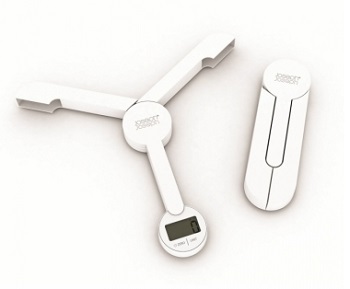
There are many convenient kitchen tools out there, but the problem with most of them is storage. Appliances take up a lot of counter or storage space, and even smaller gadgets start to add up when you have a lot of tools on hand. Kitchen scales have been getting more streamlined over recent years, but they still tend to be blocky and are often difficult to store. This Tri-Scale Folding Digital Scale is one scale that won’t take up any counterspace – and is so streamlined that it needs virtually no storage space at all.
The scale has an unusual folding design that allows it to fold down into something that could easily fit in your pocket when it is not in use. The scale has three arms that fold out around a central sensor. The arms give the design stability and enough space to hold a surprisingly large bowl or tray for such a small device. It has a large, easy to read LDC, and measures in grams, pounds, ounces, fluid ounces and mililiters. When you’re done, the arms slide in around that central point, taking up less space in your drawer than a set of measuring cups.

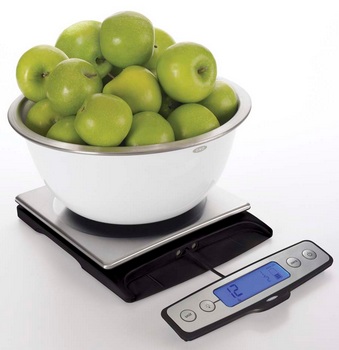
Kitchen scales are very handy to have around the kitchen, and you can use them for everything from measuring out small amounts of coffee for a french press to weighing out large quantities of flour when you’re planning to do some bread baking. As long as yours is accurate – and you can always double check the accuracy by measuring something with a known weight – just about any kitchen scale will do until you have to measure something big. Most kitchen scales measure only small quantities. They may be sensitive enough to detect a few tenths of an ounce, but they top out at a few pounds, which can be frustrating for bakers and cooks who work in larger quantities. TheĀ OXO Good Grips 22-lb Food Scale is a kitchen scale that has double or triple the range of the average kitchen scale and can handle bigger cooking projects easily.
Cook’s Illustrated recently (March/April 2013) gave this scale a try and found it to be accurate and easy to use at a wide range of test weights. It is sensitive enough to measure 1 gram or 1/8-oz weights in addition to the heavier things. The OXO scale is easy to read, with a large backlit display. The display on the scale also pulls out, which makes it easier to see underneath large bowls, platters or anything else that might stick out over the display of an ordinary scale and make it difficult to read. It also measures volume in cups and mL for water-based ingredients, as well as giving dry measures in grams/kilograms and ounces/pounds. The scale has a very low profile, so it is easy to store, but it does have a larger footprint when it is in use than many small scales have. However, if you know you’ll be doing some heavy measuring with big baking, cooking or canning jobs, a scale that is slightly larger but a lot stronger is probably the perfect tool.

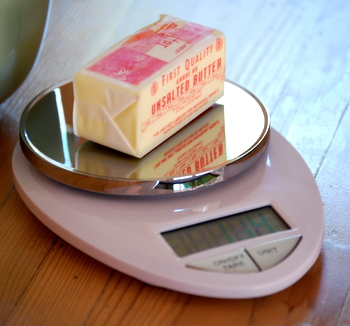
I’ve said it before, and I’ll say it again: serious bakers and cooks need to have a scale in the kitchen. The ability to weigh ingredients gives you a lot more precision than volume measures do, especially for dry ingredients like flour, where “1 cup” could be anywhere from 3.5 – 4.5 ounces depending on how hard you try to pack it into the cup (4-oz is a good standard for all purpose flour, incidentally). You can get by without one just fine, of course, but it’s nice to have. A good basic scale is the EatSmart Precision Pro Digital Kitchen Scale. It’s not too expensive, it’s easy to use and works very well.
The scale is small and lightweight, made of durable plastic that comes in a variety of different colors so that you can pick one that will fit into your kitchen. It runs on two AAA batteries that come included in the packaging and has a 3-minute auto shutoff to preserve battery life. It has a capacity of up to 11-lbs (4.98-kg), but will also measure a single gram for times when you need a very fine measurement. The feature that I like the best is the unit feature. Previous scales I’ve had require you to flip them over to change their measure from grams to ounces. On this scale, a touch of a button right on the front flips the measurement from grams to kilograms to ounces to pounds, which is very handy. Another nice thing about it is the size of the screen: it’s so large that you can almost read the numbers from across the room.

There are lots of good reasons to have a kitchen scale at home. The biggest reason is that they are far more accurate than just about any other means of measuring, especially when it comes to dry ingredients that are measured by cups for most US recipes. A cup full of flour can actually be two very different amounts, if one measure has been sifted and the other packed, even though they look alike. A basic scale will do – as long as it’s accurate, of course – but there are scales out there that offer many more features to the consumer, like the EatSmart Nutrition Scale.
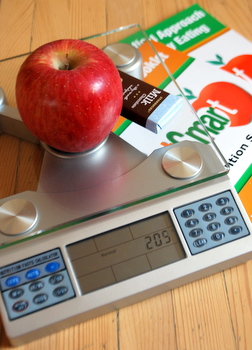
The EatSmart Nutrition Scale is a kitchen scale that calculates nutritional information for hundreds of foods in addition to weighing them. It weighs in grams and ounces, and has a database of 999 preprogrammed food items for which it can give you the nutritional information according to the weight of the item on the scale. It gives you calories, carbs, fiber, sodium, potassium, magnesium, total fat, saturated fat, cholesterol, calcium, protein and vitamin K. You can also program in up to 99 additional items, if what you’re interested in isn’t already in the scale, to have those numbers available at the touch of a button. There is also a nutrition calculator mode to adjust the stats on a nutrition label to your portion size on the scale easily.
I found the scale to be accurate and easy to use. It was fun to see the nutritional information, too. The apple pictured below was 202 grams, contained 105 calories, 27.9 grams of carbs and 4.8 grams of fiber. While I’m not usually inclined to calculate the stats for everything I make, I really liked having such an easy option. I lent it to a friend who does weight watchers and she absolutely adored it. The only downside with this particular scale is that it only goes up to 6-lbs (3000gms), so if you do a lot of bulk bread baking or think that you’ll want it to weigh out large roasts, keep that in mind before you try one out.