Archive for: pizza stone

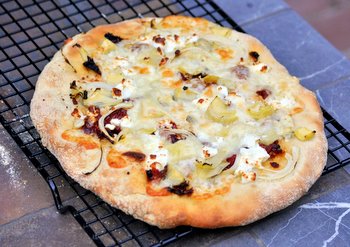
An Italian restaurant that is not too far from my neighborhood makes a pizza that they call The GCOP. This pizza may have a funny name, but it has a lot of fans. The GCOP stands for goat cheese, caramelized onions and pancetta. I’ve never been sure whether the “c” in the name comes from the cheese or the caramelized onions, but one thing I am sure of is that this is a fantastic combination of flavors for a pizza to have.
Naturally, I wanted to give this pizza a try in my own kitchen so that I could make it any time I was in the mood for a slice – or any time that I had all of the ingredients available and ready to go! I started with my favorite pizza crust recipe. The recipe uses a technique that was developed by America’s Test Kitchen. It produces a light crust with just the right combination of chewy interior and crisp exterior in a very short period of time – and it is all done in a food processor. I definitely recommend this crust, but you can use these toppings with another dough recipe if you have a favorite.
Pancetta is frequently known as Italian bacon. It is cured with salt and seasoned with pepper and other spices, but it is not smoked like American bacon is. Pancetta is typically sold in sausage-like logs, and it can be cut thick or thin, in rounds or in strips, depending on what you want to do with it. In this case, I cooked some small cubes of pancetta in a skillet with a little bit of olive oil until they were crispy and removed them to a paper towel to dry. Then, I added the my onions (and some butter, but you don’t need to add extra) to the fat left in the pan and caramelized them over a medium heat. I put a very small amount of marinara sauce on my dough, topped it generously with pancetta and onions, and then sprinkled on some goat cheese and a little shredded mozzarella. It isn’t exactly like what I had in the restaurant, but it was a great way to top a pizza. The salty cheese melds well with the slightly salty, porky pancetta and the sweet onions, and the tomato sauce adds some extra sweetness and a nice backdrop that brings everything together.
The amounts given below are approximate, as you can add as much or as little of these elements to your pizzas as you wish. They can all be easily doubled, too, if you’re doing a big batch. Feel free to add some red pepper flakes for heat or omit the mozzarella if you want more goat cheese, too.
+Continue Reading

Baking stones are large pieces of stoneware that are designed to help turn your regular oven into an oven that is perfect for baking bread or pizza. The stoneware retains a lot of heat that will cook and tey transfer heat directly to the bottom of your bread – resulting in a better, crispier crust than you could achieve by putting your dough on a baking sheet. They’re typically thought of as something for use in home ovens, but baking stones can also be used outside on the grill. The grill is an ideal makeshift pizza oven because it can get much hotter than most ovens, meaning that you get a more pizza oven-like temperature and a crisper crust in a shorter baking time.
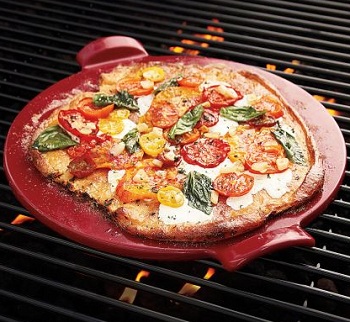
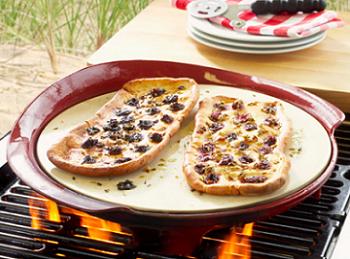
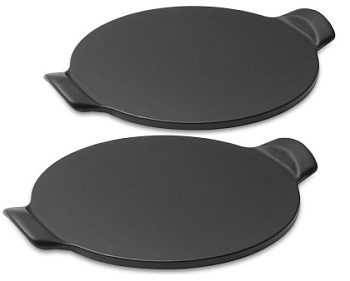
Many companies make pizza stones that are meant to go on the grill, but one of the prettiest is the Emile Henry Flame Top Pizza Stone. This handcrafted clay stone is the perfect size for a pizza and still leaves you with some room on your grill for cooking other things. It has a smooth glazed finish that makes cleanup very quick and easy (compared to natural stones, where grease and flavors can sink into the stone). Another great feature is that this stone has handles, so you can actually serve directly on the stone and remove it from the grill even while hot, which handle-less stones make a lot more difficult. Being able to turn your regular grill into a real pizza oven gives you a whole new set of options for summer grilling season. For instance, if you’re not making pizza, you can also throw vegetables on top of the stone and roast them at high temperatures while you grill steak or burgers, and you can bake regular loaves of bread on it if you just don’t want to heat up the kitchen on a hot day.

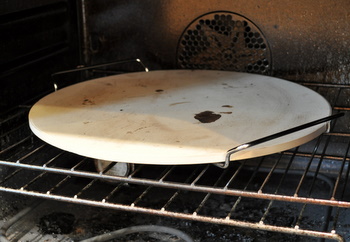
A baking stone is a large, usually thick, piece of stoneware that is often recommended for bread and pizza baking. The instructions usually say to put them on the bottom or middle rack of your oven, then preheat it for an extra-long time before baking. Using a stone is said to improve the crust of both bread and pizza, but often little explanation is given as to why this is the case.
The way that baking stones work is simple. Baking stones absorb and retain heat very well, so when you put them in the oven and allow the oven to run for a while, the stones heat up. They transfer heat directly to the bottom of your bread or other baked good, as baked goods can be placed directly on the stone (or on parchment, then on the stone) so the bread never starts out on a cold surface, as it would when baked on a baking sheet. This allows bread to bake more evenly all over, resulting in a much nicer crust – particularly for artisan-type breads. Since the stones retain so much heat, they also help keep the oven at a much more even temperature and make up for some of the heat that is lost when you open the door to put something in.
You can leave your baking stone in the oven when you’re not using it, especially if it’s on the bottom of your oven. If it’s on a rack, however, you may want to remove it when baking cakes and cookies. The extra heat from the baking stone directly underneath (say, if you’re setting a baking sheet right on the stone) can cause cakes to cook faster and cookies to overbrown on the bottom, so keep that in mind if you do decide to do your regular baking with the baking stone in your oven.
You can buy baking stones at many specialty grocers and kitchen stores, as well as online. I often see unfinished quarry tiles recommended as inexpensive alternatives to commercial baking stones, although an unfinished tile is a bit more likely to become brittle and break-able over time. The thickness of the tile should not have an impact on the results, so choose a stone that fits in your oven well and is light enough that you can handle it easily.

If you don’t have a super-hot pizza oven installed in your kitchen, it’s hard to achieve that pizzeria-quality pizza because most regular ovens can’t achieve that type of temperature. On top of that, they don’t have a stone floor on which to place the pizza. The problem of the stone is easily solved with a pizza stone, which holds a lot of heat and simulates the cooking surface of a pizza oven enough to produce a really nice crust. The only thing that can come close to a pizza oven’s temperature is a barbecue. Barbecues, whether coal or propane, can usually reach temperatures much higher than a regular oven. A special pizza stone, like the Mario Batali Chianti Pizza Stone, can easily transform your grill into a pizza oven without the need to remodel your kitchen to install an expensive specialty oven (although that would be a very nice thing to have, I must say!).
The Chianti Pizza Stone has two parts, a standstone stone onto which the pizza is placed and cooked, and a heavy-duty cast iron frame that holds the stone up off the grill. The frame helps to make sure that the stone heats evenly, and also protects it from overheating and potentially cracking on the surface of the grill. You can crank up your barbecue and enjoy a pizzeria-like pizza, with a crisp crust, chewy interior and a quick cooking time with a stone like this one. You can also use it as a kind of pan to bake other things in your barbecue – pies, tarts, cookies – if you have a good temperature control of your grill and can maintain a consistently lower heat for those items.
Of course, there is always grilled flatbread and pizza for those who just want to cook directly on the grill.
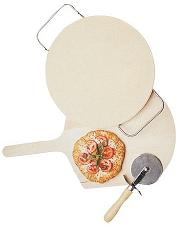
When it comes to baking pizzas at home, a baking stone is crucial for getting a great crust. The stone draws moisture out of the pizza dough as the crust bakes, preventing steam from getting trapped beneath the crust and causing your pizza to get soggy (or, at least, not entirely crisp). Even top-quality baking pans don’t give you the same effect, so it’s worth getting a baking stone if you’re making your own pie on a regular basis. Now, with this in mind, the Wall Street Journal recently reviewed five different do-it-yourself pizza kits, each with a pizza stone and the goal of helping you to perfect a homemade favorite.
The WSJ liked kits that came with extras – pizza cutters, pizza peels, rolling pins, etc. – but also took into consideration size and ease of use, which in this case translated to easily cleanability with soap and water. The stones themselves all seemed to perform equally well in terms of the pizza they produced. The “best overall” went to the All-Clad Pizza Stone set, which is small but equipped with a convenient rack for lifting the pizza out of the oven and moving it to the table. It is pricey, though, so the “best value” went to the Linens ‘n Things Pizza 101 set, which includes a huge number of extras for a very low price. They also tested (and liked) VillaWare, Crate&Barrel and Bialetti‘s offerings.
All this said, you can work with just about any baking stone to make a pizza or to make bread and it’s not crucial to get one with a specific purpose in mind (like pizza-making, although kits can sometimes be more readily available) or one with a handy removal rack, since you can leave the stone in the oven to cool. Nor do you need the “extras” if you already own a rolling pin and pizza cutter, but the sets are nice and if you’re planning on trying to take the next step in your baking abilities, it doesn’t hurt to have a review or two to help you out.