Archive for: meringue

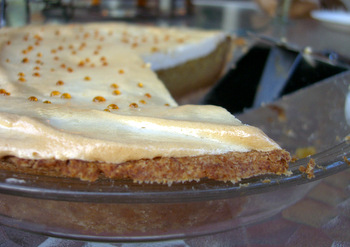
Many types of pies are topped with billowing meringues that give them a beautiful finished look and a lovely contrast between a denser filling and a lighter topping. But even though the meringues look good when you spoon them on top of a pie, they often start to weep and make your pie look less than perfect. Weeping is when a meringue releases droplets of liquid, giving the meringue the appearance of having tears or raindrops all over it – hence the name. Weeping is caused by an unstable meringue, one that is undercooked or that it simply has too much moisture in it.
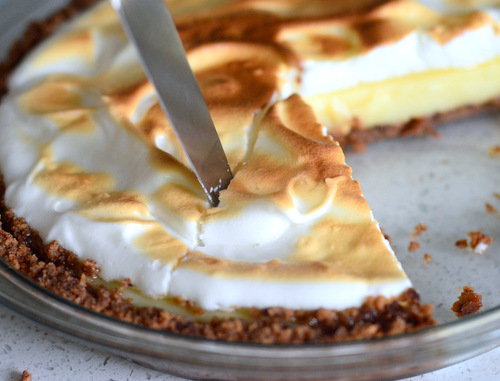
Many pies are topped with a meringue made by beating sugar and egg whites together, spreading it onto a hot pie and baking it for a few minutes in the oven to brown it. This method generally sets the outside of the meringue and counts on the heat from the pie to help set it from below. Unfortunately, a few minutes in the oven isn’t really enough time to fully stabilize a meringue and meringues made in this way will often shrink, separate from the crust and start to weep after a short while.
There are a couple of solutions to the problem. One option is to extend the baking time slightly for your pies, giving the meringue more time to cook through. Another options is to add a stabilizer – such as cornstarch – to your meringue to help to absorb excess liquid. A tablespoon or so should be enough to help control the weeping initially, and it is easy to incorporate into a meringue. The stabilizer will help your meringue to last longer than one with nothing added, but once the pie is in a humid environment, such as the refrigerator (or your kitchen, if you live somewhere it is very humid), it may begin to weep anyway.
The most reliable way to prevent weeping is to replace a simple meringue with a very stable Italian Meringue. Italian meringue is made by beating egg whites until they reach soft, fluffy peaks, then slowly streaming in boiling sugar and beating the mixture until it is thick and glossy. The resulting meringue is fully cooked so it is very stable and it is significantly less likely to weep than an uncooked meringue (typically only in very humid conditions), and you can spread it on top of a pie and bake it until it browns in the oven without worrying about having an under-cooked meringue on your dessert.

Meringue-topped pies and angel food cakes need a lot of egg whites. It can be tempting to reach for a carton of prepackaged egg whites in the grocery store when you know you are going to need a lot, rather than separating a dozen or more whole eggs yourself. These processed products might do in a pinch when you’re looking for a way to cut calories from your breakfast scramble, but do they work in other egg white applications? Cook’s Country picked up for widely available varieties of processed egg whites to put them to the test in a recent issue (Feb/March 2013) to see how they held up to the real thing.
Their test included three brands of liquid egg whites and one brand of powdered egg whites. They were tested in omelettes, baked goods and meringue cookies, then compared to versions made with freshly separated egg whites. The test kitchen found that all of the products were acceptable in omelettes, but none worked as well in egg white-heavy baking applications. This is largely because of the pasteurization process that the liquid egg whites have gone through, which toughens the egg proteins so that they don’t stretch as easily when whipped, so they need a lot more time to get the same volume as fresh egg whites.
The top-ranking product in the test was Eggology 100% Egg Whites, which turned out a great omlette and an acceptable angel food cake. The meringues made with them were still acceptable, but overly crunchy when compared to fresh egg white versions.
The rest of the tested products ended up being “recommended with reservations.” Organic Valley Pasteurized Egg Whites tasted good in omelettes, but took an astounding 22 minutes to beat to soft peaks (fresh egg whites took just 6 minutes). Deb El 100% Dried Egg Whites were grainy in omelettes and meringue, but whipped up quickly and were easy to work with.
Egg Beaters All Natural 100% Egg Whites finished at the very bottom of the pack when it came to baking. Although they made a very good omelette, the twice-pasteurized egg whites did not whip properly or rise in the oven when baked.

Italian meringue is made by beating egg whites until they reach soft, fluffy peaks, then slowly streaming in boiling sugar and beating the mixture until it is thick and glossy. A basic meringue, also known as a French meringue, is made by beating granulated sugar into egg whites until the mixture reaches soft peaks. The hot sugar syrup used to make Italian meringue essentially cooks the egg whites as it is incorporated. This means that you don’t need to cook or bake the meringue before using it. It also means that the meringue is going to be a lot more stable and less likely to deflate or weep than a simple meringue is.
When making an Italian meringue, it is important to add the boiling sugar syrup very slowly, so that you don’t accidentally cook your eggs by overheating them. It is also important to keep the mixer (or your arm, if you are buff/brave) working on a medium-low speed while you work, so that the syrup is incorporated consistently without flying off the whisk attachment or beaters of your mixer. Once the syrup has been incorporated, the meringue is beaten at high speed for several minutes until it has cooled down. Unlike a simple meringue, you cannot overbeat an Italian meringue, so there is no need to worry about that. Once the meringue has cooled down somewhat (some recipes will call for it to be warmer or closer to room temperature for use), it can be used in a variety of recipes.
You’ll frequently see Italian meringues called for as pie toppings, especially for Lemon Meringue Pie, and in desserts like Baked Alaska. Italian meringues are used in some macarons and the meringue can also be piped and baked to make plain meringue cookies. One of the most popular uses for Italian meringue, however, is making rich, buttery Buttercream Frosting, where butter is beaten in to an Italian meringue until the mixture is transformed into one of the most decadent ways to top of a cake or cupcake.

Last year, I was fortunate enough to be a judge at the American Pie Council‘s Crisco National Pie Championship in Florida. I got to taste dozens of pies and helped pick out the best in show. I would have done it again for their 2011 contest, but I was out of the country when the championship was held. I’m giving the pie contest a nod by baking one of their winning pies at home! The Engagement Ring Pie was the best-in-show winner in the professional category, baked by Bryan Ehrenholm of The Lunch Pail in Modesto, California. The pie was inspired by the royal engagement of Prince William and Kate Middleton and is “is rich with history of English walnuts and dates, graced by a meringue crust and is topped the deep color of blueberries and encircled with the lightness of whip cream and diamond dust.”
Although the pie has some historic ingredients in it, it is hardly a traditional pie. The base of the pie is not a regular pie crust, but is a light meringue that is baked until it is crisp on the outside and chewy within. It is topped with a lightly sweetened and very shiny layer of glazed blueberries and garnished with whipped cream. It is striking to look at and very interesting – and tasty – to eat. The pie is sweet but not overly sweet, despite the meringue base, and has a very unique combination of flavors and textures to it. The topping is very flavorful thanks to bright, fresh blueberries, and has a little bit of richness to it from the glaze. The meringue is both crisp and chewy, but with a lightness that contrasts well with the topping. It is surprisingly flavorful from all of the nuts, dried fruit and vanilla wafers inside.
The pie base can be prepared a day in advance and kept, uncovered, at room temperature. Once the pie has been topped, it is best the day that it is made. The “diamond dust” in the original description is actually a type of edible glitter for cakes that can be found at craft and cake decorating stores. It adds a little extra “bling” to the pie, but isn’t necessary unless you are actually going to bring this out at an engagement party!
If you’re not celebrating the royal wedding, you can easily make variations on this pie to suit your own tastes. Other fruits would work well in the topping, such as raspberries or a combination of other berries. You could substitute pecans into the meringue for the walnuts – and you can use either toasted or untoasted nuts. As for the fruit, you can even change out the dates for other dried fruits, including plums (my top choice for a substitution here), apricots and even raisins. You can opt for a coarse or fine chop of your ingredients, but I found that I preferred a slightly finer chop of the dried fruits and nuts.

+Continue Reading

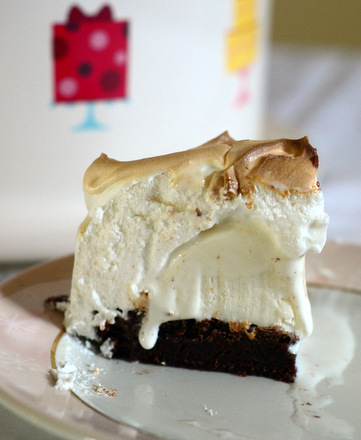
I don’t usually trot out a big plate of brownies for dessert on a special occasion (although occasionally one will slip in there!), but brownies can be the basis for a fabulous and elegant dessert: Baked Alaska. Baked Alaska is a dessert that consists of a brownie base topped with ice cream, then covered in meringue and baked until browned. The “alaska” part of the dish is the ice cream, while the “baked” is, obviously, the fact that you brown the whole thing in the oven. The meringue browns very quickly in the oven, so there isn’t enough time for the ice cream to melt, so the dessert stays beautifully intact and has a nice hot-cold aspect to it when you serve it.
You need some baked, cooled brownies to start with. I use homemade brownies, though storebought and box mix brownies will work just fine in a pinch. Vanilla ice cream is traditional for this recipe, but you can really use any flavor you like. Because you don’t bake the meringue for very long, I cook the meringue in advance by beating a hot sugar syrup into beaten egg whites. The meringue is soft and marshmallowy, and takes on a great toasted-marshmallow flavor when it comes out of the oven. You could use an uncooked meringue, but the dessert doesn’t really spend enough time in the oven to cook all the way through in just a few minutes, so you might want to consider pasteurized eggs if you prefer to go this route.
You can make Baked Alaska with one brownie if you’re going to make a single serving or a dozen brownies if you want to feed a crowd. I’m going scale this to make 4 single-serving Baked Alaskas, but change the quantities to suit your needs when you’re trying it yourself!

+Continue Reading