Archive for: decorating

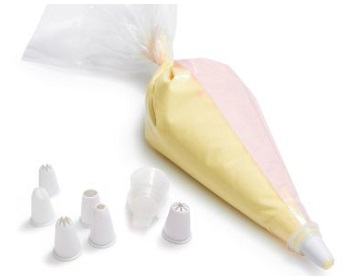
Most of the time, cupcakes are frosted with just one color of frosting. You can make two tone frosting by mixing up two different colors of frosting and putting them both into the same piping bag, allowing you to squeeze out a marbled frosting with both colors. This latter method definitely works, but it is difficult to get the colors distributed evenly into the bag, so you’ll end up with some cupcakes that have a lighter swirl and others that have a much darker one, while other times the colors will just completely run together. The solution is a piping bag with two chambers so that you can fill one side with each color and know that you’ll get equal amounts of each color on your cake and that the icing colors won’t blend into one color you weren’t anticipating.
This Duo Icing Set offers just that. The set includes a total of eight disposable icing bags, each with two chambers that allow you to use multiple frosting colors with ease. Four bags are 18-inch and four are 12-inch bags. The set includes six different tips for making everything from thin lines to stars to flowers, and also includes a coupling set that allows you to attach the tips onto the outside of the bag, making it easy to change the tip multiple times on one project. When you run out of bags, you can order a replacement set of them that includes either 10 large or 20 small bags, keeping the tips from this first set to use over and over.

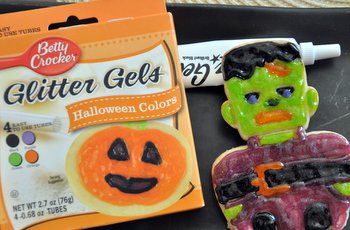
When it comes to decorating cakes and cookies, I like to keep things simple. Around the holidays, however, I usually feel the need to take some of my creations over-the-top and put more work into the decorations to make them stand out. Halloween is definitely a holiday of colors, and you’ll see orange, black, purple and green everywhere you go. That color palate is what made Halloween Glitter Gels from Betty Crocker catch my eye in the decorating section of my local market. It can be difficult to find (or make) black food coloring, and the fact that there was a black color in the box made me give them a try.
This type of gel frosting is typically used to decorate the tops of cakes, and the squeezable tubes are handy for writing “Happy Birthday”- type messages. This box showed pictures of decorated cookies, which made me wonder if the gels were a bit different than some I’d used before, and if they might be a good choice for decorating Halloween cookies.
The gels ended up having both strong and weak points. The colors looked awesome – rich and vivid, with just enough glitter to make them pop without looking silly – and the tubes were easy to use. I was able to get very detailed designs onto my cookies with ease. Unfortunately, the gel stayed wet and sticky for a long, long time (more than 12 hours), so it made handling the decorated cookies a little bit difficult. I think that they should change the picture on the packaging to show decorated cupcakes, instead of cookies, because I would definitely use these to add some Halloween color to a cake, but I will stick to other (homemade) frosting options to decorate cookies next time.


One easy way to get a design on top of a cake or cupcakes is to use a stencil. The stencil typically involves some sort of cutout design that is placed over the top of the cupcake, then cocoa powder or confectioners’ sugar is sifted over the pattern. When the stencil is removed, all you have left is a sharp design on top of your cake. I often make my own stencils using thick paper, which is easy to do and allows you to make your own patterns. The drawback to this is that even thick paper can bend when you’re working with it, leaving you with unwanted piles of sugar (or other materials) as you try to sift on your design. Paper stencils also do not store well, and it can be difficult to do more than basic designs when you have to cut them out yourself.
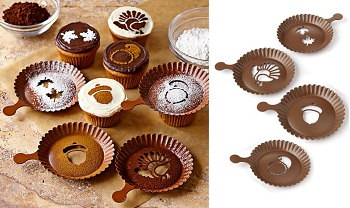
Stencils seem to be becoming more widely available, and stiffer stencils made of plastic, metal and other materials are becoming easier to find. This Autumn Cupcake Stencil Set from Williams Sonoma is a good example. The stencils are made of sturdy nylon and feature fall-themed designs that are detailed – but still simple enough that they make for a clean, easy-to-read transfer. Unlike a paper design, these have a built-in curve to them that allows them to conform to the shape of your cupcake (frosted or unfrosted) and that also helps to ensure that you get a sharp image in the end. These stencils are reusable, too, so they can be used throughout the fall baking season.

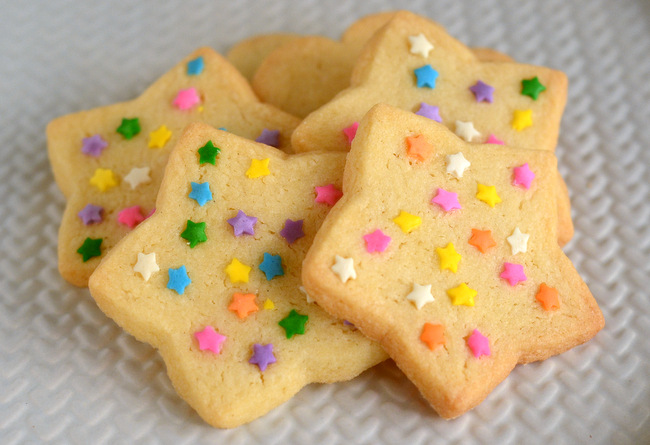
Adding sprinkles seems like an easy way to decorate a batch of butter cookies or other relatively plain-looking cookies for holiday or some other festive occasion. They’re bright, colorful and, unlike frostings and glazes, need no prep time. But sprinkles can come with their own problems because they don’t always end up where you want them to be; frequently, when you’re applying sprinkles, you end up with more on the baking sheet than you do on the cookies themselves! Sprinkles have a hard time sticking to dough that isn’t tacky enough. For instance, when cookie dough is rolled out on a lightly floured surface, it picks up some flour so that it isn’t sticky and can be handled easily – and that same flour will prevent sprinkles from sticking to the cookies.
There are a couple of simple things that you can do to help those sprinkles stick. The easiest thing to do is to brush the tops of the cookies with a little bit of water or milk, using just enough to dampen the cookie dough and no more. This will help the sprinkles stick and won’t change the finished appearance of the cookie when you’re done baking. You can also brush the cookies with a little bit of egg white, which will provide some adhesive, but will also make the cookies appear a bit darker and shinier. Take a sheet of notebook paper and fold it in half. As for technique, pour the sprinkles down the “channel” to direct them onto the cookies, rather than shaking the container of sprinkles all over the baking sheet to eliminate the mess and waste usually associated with sprinkle-ing cookies.
Finally, if you’re using big, round sprinkles, you’re going to need to press in the sprinkles when you apply them. Large nonpareils, for instance, need to be “anchored” into the cookie dough, or they simply won’t stay put on the trip from the countertop to the oven.

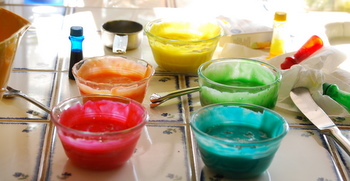
Most supermarkets carry one basic type of food coloring, a water-based liquid that comes in red, blue, green and yellow. This type of food coloring works pretty well for most purposes. You can dye Easter eggs with it, get creative with cake batter colors and even add it to drinks to make things like plain milk a little more “interesting” (which I did as a kid). But when you are aiming for a really intense, vibrant color – such as the signature red of Red Velvet cake – food coloring can cause a lot of frustration because you need to add a lot of it to get that much color. This isn’t a problem for most recipes, as a tablespoon or so of what is basically water isn’t going to hugely impact the outcome. But for some recipes, it can negatively impact the recipe (with too much liquid/throwing off the consistency) as well as give you a headache as you try to figure out how much to add.
I like to use gel food colorings for this very reason. These food colorings, also sometimes called icing colors, usually have a corn syrup and/or glycerine base and a much, much more intense color than regular food colorings. You don’t have to use nearly as much coloring – sometimes only a few drops – to get the same color effect (or better) as you would with several times as much regular food coloring. Less liquid means that these colorings will work better in candies and frostings, where the amount of liquid in the final recipe can be quite important. Since you use less, I find that these last longer than other colorings, too. You can find them online and at craft stores (sometimes kitchen stores carry them, as well) and they often come in more colors than the plain variety from the market.