Archive for: cake flour

What does sifting flour do?

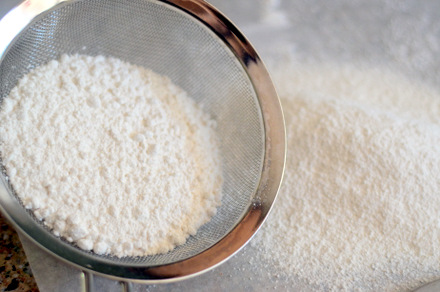
Sifting Flour
Some recipes call for sifting your flour. Other recipes call for flour that has been sifted. Still other recipes don’t specify whether your flour needs to be sifted or not – and with all the options, this raises the question of what does sifting flour actually do?

Sifting flour is a way of aerating your flour and making sure that there are no large lumps in it. Flour is very finely milled and it is typically packed in small bags, where it gets packed down easily. This is especially true of cake flour, which has an exceptionally fine texture. Depending on the climate you live in, your flour might also develop lumps due to very high humidity and it can even attract small bugs, and sifting eliminates both of these problems. When a recipe calls for sifting flour together with other ingredients – such as cocoa powder, leavening agents or salt – it is to help disperse those ingredients into one mixture before adding them to a recipe.

Aerated flour – as opposed to packed-down flour – is easier to mix in to recipes. For most recipes, giving your flour a few gentle stirs with a knife or whisk to aerate it while it is in your storage container is enough agitation to break up any big lumps that might be present and prepare the flour for use in a recipe. As long as you are gentle and don’t pack the flour very firmly into your measuring cup you shouldn’t have any problems when you use it, even if the recipe calls for sifting your flour after measuring.

When a recipe calls for flour to be sifted before measuring (i.e. “1 1/2 cups sifted cake flour”), however, you should take care to sift your flour before measuring. Sifted flour does have more air dispersed in it than unsifted flour, and there are some delicate recipes where having the flour as aerated as possible – such as angel food cakes – will produce a better, lighter finished product.

What is unbleached flour?

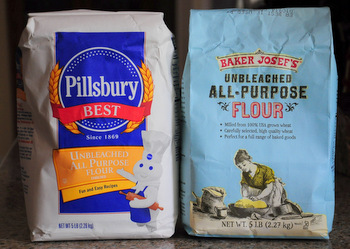
Unbleached All Purpose Flour
Unbleached flour is refined flour that has not had any whitening agents added to it. Bleached flour is flour that has been whitened – i.e. bleached – using chemicals. Bleaching flour does not have much of an impact on the flavor of the flour – although some people say that they can taste the difference, so if you are very sensitive you may fall into this category – but it does change the color of the flour to a bright white. Bleaching also serves to lower the protein content of the flour, softening it so that baked goods made with it will be more tender. Most cake flours, for instance, are bleached.

Unbleached flour has a pale off-white color and the difference between it and bleached flour is very clear when you put the two side by side. Unbleached all purpose flour is widely available and is a good choice for just about all baking projects, regardless of whether the recipe specifically calls for unbleached flour. In fact, a good number of bakers these days use unbleached all purpose flour exclusively (using only bleached cake flour in recipes that specifically call for it), so many recipes are designed with it in mind.

Baked goods made with bleached flour may have a slightly softer texture and a brighter color than those made with unbleached flour. You’re probably not going to notice a significant difference in a batch of chocolate chip cookies made with unbleached vs bleached flour, but you may notice that your angel food cake is lighter, whiter and softer when made with flour that has been bleached because the difference is much more obvious in that type of baked good.

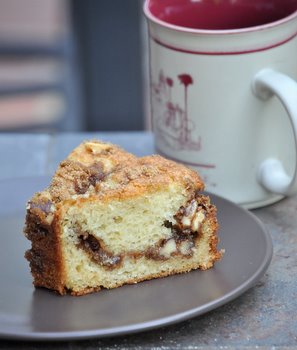
LAUSD Sour Cream Coffee Cake

LAUSD Coffee Cake at home

School lunches these days aren’t typically anything to write home about, although there are plenty of chefs, parents, students and other activists out there trying to change school lunches to be healthier, fresher and tastier. But school lunches weren’t always something to dread. In fact, they used to be downright tasty – even in the Los Angeles Unified School District, which is the biggest school district in California and the second largest in the country. I can’t say that I remember them being particularly good back when I was a student, but judging from this Sour Cream Coffee Cake that was served in Los Angeles schools back in 1959, I am positive that it was at some point in time.

This coffee cake is excellent. A great balance of moist vanilla cake and sweet brown sugar and walnut filling. The recipe is easy to make, beautiful to serve and more than satisfying to eat – and it probably goes just as well with a carton of milk as it does with my coffee. The cake is baked in a tube pan, and gets a layer of filling in between layers of cake, as well as a generous portion of the filling mixture on top. The recipe has been published a couple of times, and this version was printed in the LA Times several years back along with several other classic LAUSD recipes.

The cake uses a blend of cake flour and all purpose flour, to give it a light and soft texture. I definitely recommend using the two types of flour (if you have pastry flour, you can substitute that for both flours) or use less all purpose flour to substitute for cake flour (see this post for details). The filling doesn’t have any spices added to it, so it gives you a excellent butter and brown sugar flavor in the finished cake. You can, however, spice it up by adding cinnamon or any other spice you like to the filling mixture. The filling also includes a fair amount of walnuts, which have a rich, buttery texture that works well in the coffee cake. Pecans would make a good alternative if you want something besides walnuts.

+Continue Reading

What is cake flour?

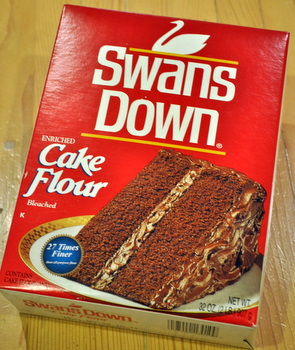
Box of Cake Flour
All purpose flour is the standard flour for home baking, but a glance down a well equipped grocery store baking aisle is enough to tell you that there are many other types of flour available for baking. Cake flour is one of them and, if you like to bake, it should be a staple in your kitchen. Cake flour is a low protein flour that is made from soft winter wheat. It has a protein content of about 8% and is usually bleached, which gives it a very fine texture and a very light color. Because it has such a fine texture, cake flour should be sifted before incorporating it into a recipe to prevent clumping.

As the name suggests, cake flour is great for making cakes and other baked goods because it gives you a very tender result. This is because it has such a low protein content compared to other flours (all purpose is usually around 10%) and less gluten forms when you mix it into a batter, producing a cake with a fine, soft, even crumb. Although all purpose flour can yileld a great cake, there is generally a noticeable difference in the texture between a cake made with all purpose flour and one made with cake flour. You can make any kind of cake with cake flour, but it is commonly flour in white cakes and in angel food cakes, both of which are known for having a light texture.

There are many recipes that specifically call flour cake flour, but you can substitute it into a recipe that calls for all purpose flour, too. Use 1 cup of cake flour plus 2 tablespoons for each cup of all purpose flour called for. By the same token, you can substitute all purpose flour for cake flour in a pinch by using 1 cup of all purpose flour minus 2 tablespoons for each cup of cake flour called for in a recipe. Still, it is best just to use cake flour instead of approximating it if you want to get the best results from your recipes.

Subbing all purpose flour for cake flour

A question I get asked on a regular basis is “Can I substitute all purpose flour for cake flour?” It is far less common to hear the reverse (although I have actually done so in recipes when I was out of flour and couldn’t be bothered to go to the store), since if you have one kind of flour at home, it will generally be all purpose.

The answer to the question is yes, but the substitution is not one-to-one. The general rule of substitution is 1 cup of all purpose flour minus 2 tablespoons (1c – 2tbsp) is equivalent to 1 cup of cake flour. If you want to substitute cake flour for all purpose, use 2 cups of cake flour plus 2 tablespoons (2 cups + 2 tbsp). If you do decide to use this sub, treat the all purpose flour just as you would cake flour (sifting before measuring, etc.).

Now, that said,I would highly recommend that you stick with whatever type of flour your recipe calls for, even when it means going out to the store to buy a box. The substitution is fairly reliable, but this is definitely a “substitute at your own risk” sort of thing. Different flours have different protein (gluten) contents and different weights, and different flours can result in dramatically different results in different recipes. All purpose flour has about 11% protein content, while cake flour has 6-8%. Some recipes need that low protein content to remain tender and light (like Angel Food Cake) and others are flexible enough (like some cakes or loaves) to use the substitution, but knowing that all purpose flour is so much “stronger” than cake flour should help you decide when you can substitute and when you may not want to.

Note: Some advocate using 1 cup of all purpose flour minus 2 tablespoons plus 2 tbsp cornstarch  as a substitute for cake flour. This should work just as well, perhaps better, as the gluten-free cornstarch can cut down on the protein content of the all purpose flour. It still won’t produce results quite as good as cake flour and involves an extra step from the one I mentioned above, so I personally prefer the simpler sub. But going out and buying cake flour (or all purpose) is always going to be your best bet.

Visit Us On FacebookVisit Us On PinterestVisit Us On TwitterVisit Us On YoutubeCheck Our Feed