Archive for: browned butter

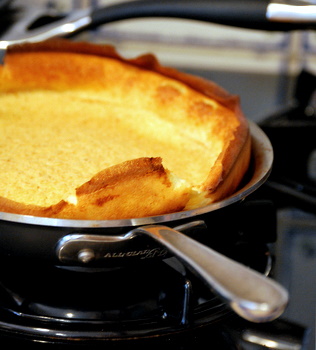
A Dutch baby pancake is a big, puffy, custardy pancake that is baked in a skillet in the oven. If it came down to it, I would say that it’s a little bit like a cross between a pancake and a popover, only better. The babies are easy to make, but take a little longer than regular pancakes to cook, so I tend to save them for lazy mornings when I am planning to sit around and enjoy a leisurely breakfast. I like a basic Dutch baby with lots of maple syrup, but I gave this one a little more depth of flavor by adding browned butter to the recipe. It only took a couple of minutes to brown the butter and add it to the batter, so not much extra cooking time was added for a lot of extra flavor.
Since you need to brown the butter for this recipe, it doesn’t really make sense to brown the butter in one pan and preheat another skillet up in the oven, a step which is typically part of the technique used to get a high rise on these pancakes. Instead, just prepare the pancake batter and preheat the oven, then the brown the butter in the pan you intend to use to bake the Dutch baby. Whisk the browned butter quickly into the rest of the already made batter, then transfer everything back into the hot and greased pan (with all of that nice browned butter flavor there, too) and slide it back into the oven to finish cooking.
The dutch baby will sink a bit as it cools, so don’t worry if it deflates a little before you serve it (although like a souffle, you basically want to serve it as soon as it comes out of the oven). The pancake will still have nice crisp edges and a firm, yet slightly custardy, center to it.
+Continue Reading

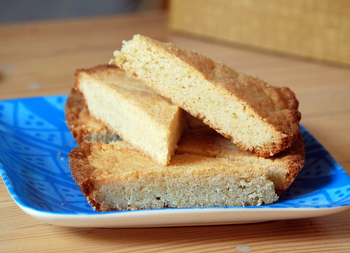
It’s hard to resist a good shortbread. It shouldn’t be too crumbly or too crisp, and it must have a rich butter flavor. This recipe makes just a small batch of shortbread that is pretty close to that good, middle-of-the-road shortbread that is well balanced, flavorful and should appeal to absolutely everyone.
This shortbread uses melted butter, which I browned on the stovetop to give it a toasty, nutty flavor that adds a lot of richness to the finished cookies. To be honest, skipping the browning step doesn’t hurt the shortbread too much, but it doesn’t take much time and the results are well worth it. The recipe was inspired by some Dutch shortbread I had, which a Dutch friend made and shared with me. After a little bit of research, I was able to find some recipes similar to the shortbread she made online and used those as a starting point for my version. The browned butter was an element that I couldn’t resist adding to enrich the overall flavor.
This shortbread is baked in a pie or tart pan and is cut into wedges to serve. It is good right away, but will also keep well in an airtight container for a couple of days.
+Continue Reading

Most tart doughs don’t have a very distinct flavor of their own, and if they are flavored, it’s usually something to complement the flavor of the tart filling, as is the case when you add lemon zest to the dough for a lemon tart. Otherwise, the tart crust adds texture but its flavor stays very much in the background. The Browned Butter Tart Dough makes a crust that has a great flavor on its own, a flavor that you don’t want to cover up with a too-rich filling. I think it works best for fillings with relatively subtle flavors, like citrus and vanilla.
I made this lime meringue tart specifically to go with the browned butter base. The zesty lime is bright and not too sweet, and its tartness is cut nicely by the rich flavor of the crust. The meringue topping adds a lightness and sweetness that brings everything together. This filling could, of course, be used with any type of tart crust and will work for any 9-inch tart.
The crust should be prebaked and cooled before making the filling. The lime curd is an easy, lower-fat variation on a traditional lemon curd that is made with lots of fresh lime juice. Fresh limes will definitely give you the best flavor here. I used a cooked meringue – egg whites beaten with hot sugar that “cooks” the whites as they whip – because it is more stable than uncooked meringues, and doesn’t need to go under the broiler to set up. I used my kitchen torch to give some color to the top, but that step is completely optional. You should make the lime curd right before making the make the meringue, because the two will seal together better if they both go onto the tart warm. You could also used lightly sweetened whipped cream as a topping for this tart in place of the meringue.
+Continue Reading

When I first saw David Lebovitz mention a new (to him, at least) tart dough technique, I was intrigued. There are all kinds of dough that you can use as the base for a tart, but most are similar to pie dough or pate brisee, where cold butter is cut into a flour mixture and either rolled or pressed into a pan. This tart dough recipe is more like the dough for choux pastry. It starts off with a hot, melted butter mixture into which flour is stirred to create a dough. Definitely non-traditional, but it is easy to make a produces a great result.
The original recipe David discussed, which he got from a pastry loving (and teaching) friend, Paule Caillat, in Paris, calls for heating the butter mixture in the oven in an ovenproof bowl until it is hot. I found this idea to be, well, a little unsafe. I hate handling water baths or any other liquid in the oven and I didn’t like the fact that I couldn’t monitor the mixture as it cooked. Instead, I chose to cook my mixture in a saucepan on the stove until the butter began to brown and created a base with a rich, deep, toasty flavor. Another advantage to using the stovetop is that you are easily able to handle the pan when you go to stir the flour in; there is no need to fuss with potholders, a hot bowl, a spoon and flour all at once!
Once cooled, the dough can be pressed into a tart pan and used as an uncooked pastry base or prebaked to support a filling that doesn’t need to be baked itself. The crust is tender, crisp and melts in your mouth. The browned butter flavor comes through in the crust alone and will add a great accent to all kinds of fillings. A chocolate truffle filling might overwhelm its flavor, but a cream cheese and fresh fruit filling or a lemon curd filling would be a great match here.

+Continue Reading

Browned butter is made by cooking butter until the milk solids in the butter begin to toast and turn a lovely brown color. This is typically done on the stove in a sauce pan, over medium or medium-low heat where it can be watched closely for color and doneness. The solids in the butter can go from toasted to burnt very quickly. This is a fine way to brown butter, just as using a double boiler is a fine way to melt chocolate. Now, chocolate can be melted more quickly in the microwave as long as you keep an eye on it to prevent it from burning. The same is true for butter: it can easily be browned in the microwave.
Put your butter into a large, microwave safe dish and heat it in 1-minute intervals in the microwave, checking after the second minute to look for brownness bubbling away at the bottom of the dish. Try using a 4-cup size bowl for 1 cup or less of butter because the butter will puff up and expand as it cooks, and will definitely bubble over the top of the bowl if you aren’t using one that is large enough. The whole process will take about 3-4 minutes, depending on how much butter you’re cooking. You’ll see lots of brown flecks floating in the butter when it is done (these are the milk solids). Once the butter is cooled, you’re ready to incorporate it into any recipe.