
When recipes call for uncooked eggs, many cooks shy away from them. There is good reason for this, of course, since there is a small chance that raw eggs contain salmonella. This is a very small risk to begin with, and few recipes call for uncooked eggs (mayonnaise and some mousses, just to name a few), but you can always pasteurize your eggs to ensure that they are absolutely safe to use even when they are uncooked.
Pasteurized eggs are eggs that are cooked briefly at a high temperature and then cooled. The yolk must reach a temperature of about 138F. Eggs scramble at a much higher temperature, so it is possible to heat the yolk to pasteurize it without cooking the egg. The eggs still have the consistency of raw eggs (and can be used just like them in any recipe) but microbial growth of harmful bacteria is slowed or eliminated. You can buy pasteurized eggs at some markets, but they’re usually difficult to find and expensive. I tend to pasteurize a few eggs at a time before I use them but if you have a feeling you’ll need a lot, you can do it when you first bring eggs home from the market. You can store the pasteurized eggs in the refrigerator (as you would with regular eggs) and not worry about them again.
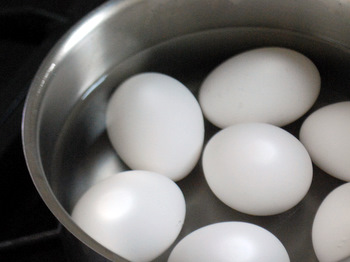
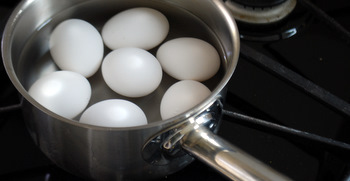
To pasteurize large eggs, place them in a saucepan filled with water and fitted with a digital thermometer. Turn on the heat and bring the water up to 140F.
Keep the water temperature at 140F for 3 minutes (and no more than 142F), reducing the heat on the burner if necessary. Remove eggs from hot water and rinse thoroughly with cold water.
Store in the refrigerator until needed or use right away.
Jumbo sized eggs need to 5 minutes in 140F water.
Disclaimer: I feel compelled to mention that I cannot absolutely guarantee that this method is going to completely eliminate the 1 in 20,000 chance that an egg you have might have salmonella, although as long as your egg reaches the appropriate temperature, it should be effective.
This is a method that I, and many friends who are chefs/culinary professionals, use to pasteurize our eggs when we need them. The vast majority of bacteria associated with an egg is found on the eggshell. The fresher your eggs are, the better they are. You can buy pasteurized eggs in some grocery stores and you can read more about egg safety here.
Naturally, I would recommend that anyone pregnant, etc. avoid raw eggs just to be on the safe side.




Pattypro
March 10, 2011Awesome! So much easier than tempering milk, egg, sugar, etc. for ice cream bases and having to wait for the cool down.
Heidi
March 10, 2011I never knew how to do this! Thanks for the tip, Nicole!
Katy
March 10, 2011Unfortunately, although this method has been widely circulated, the official word is that shell eggs CANNOT be safely pasteurized using home kitchen equipment. Straight from the USDA’s website – http://www.fsis.usda.gov/factsheets/focus_on_shell_eggs/ .
Andrea Dorn
March 10, 2011Would you recommend a good digital thermometer please??
Carlyn
March 10, 2011YES!! Now I can make chocolate dipped cookie dough balls out of my favorite chocolate chip cookie recipe!! I didn’t want to buy a whole dozen when all I needed one pasteurized egg, thanks so much!!!
Bake for a Queen
March 10, 2011Great tip! Coincidently I was looking around for pasteurized eggs but they are so hard to find. Thanks to you I can now make my own. Thank you =)
Monica
March 10, 2011So cool – thanks!!!
pumpkinpie
March 11, 2011that is very useful information! thanks.
Nicole
March 11, 2011Katy – Thanks for the link. The FDA approves facilities that pasteurize eggs. It is possible that they’re just referring to the “approved” equipment with that quite, as the method used at some commercial facilities is not all that different from this one. Commercially pasteurized eggs are also coated with wax to “seal” them after pasteurization.
Liz
March 11, 2011The method that at least one commercial producer uses is very different than this method. The commercial method guarantees that the proper temperature is reached all the way to the center of the yolk without cooking the egg.
Bacteria multiply rapidly between 40 and 140 degrees F. If the yolk (where bacteria gets its nourishment) is not properly heated, you will be creating a very hazardous situation.
The UEP (egg producers) use the 1 in 20,000 figure. FDA and agricultural studies show the risk to be more like 1 in 5,000. Sometimes 1 in 10,000 is used as a compromise.
Remember, chicken eggs are really chicken meat. They should be handled and prepared carefully.
Here’s an exceptionally well done animation that can help you understand how salmonella can be found inside eggs:
http://www.virtualchicken.org .
Nicole
March 11, 2011Liz – Good info!
sam
August 4, 2011Thanks, but I think I’ll stick with my farm fresh eggs & not worry about any disease, way more nutrients that way & even thru pregnancy I would have just about a daily raw egg in my smoothy. But of course, the key here is farm fresh, and hopefully pasture fed, organic is even better – stay away from the stuff in the stores…
Jaime
August 10, 2011Egg safety advice from the American Egg Board. Sure.
I got salmonella poisoning from a neighbor’s eggs. I was in the hospital for 3 days and wanted to die.
Wouldn’t touch a raw egg again if you paid me.
I learned a lot about salmonella (www.virtualchicken.org) and how it gets in the chicken and how it’s passed into the egg. It’s not as uncommon as you think. And all very natural too.
BH
January 2, 2012Well Katy, if the USDA say so, well then it MUST be true. Now let’s head off to Iraq, I hear from a good source they have WOMD.
Great pasteurizing tip, thank you.
Hall
February 10, 2012the REAL temperature for EGGS, and salmonella specifically is 160F Minimum !
to be sure, and it’s better safe then sorry with eggs,
they will still digest very well after keeping them at 160F for 10mins (:
david
April 1, 2012hey, if you read the link katie said, it doesn’t say that you cannot do it at home, it says that it is difficult to do without cooking the egg.
Kurt
April 11, 2012BH – are you seriously of the opinion that if the Department of Defense lies about WMD, then it logically follows that you can’t trust the USDA for food safety advice? Or do you have any scientific facts that prove that the USDA figures/information are fraudulent? If so, please do share.
bobby garcia
May 16, 2012How long is it safe to kept fresh laid eggs from our hens. We wash them in anti bactercal soap and place in refrigerator.
Linda
July 4, 2012It’s pretty amazing that a simple topic as raw eggs can generate so many responses. I appreciate the info you have given us Nicole. I don’t trust the commercial eggs to be pasteurized correctly. I have purchased the liquid eggs which are supposed to be pasteurized, but what egg did they use? Was it an easy way to use up old eggs and get the public to buy them? I just don’t know. Of course I wouldn’t trust eating raw home grown eggs either. I have had chickens and many eggs from them, but to eat them raw – no thanks! Now with the knowledge of how to make safe raw eggs, I feel I can do it.
It’s much like raw milk, I understand the risks and it is my choice as it is every one else’s to do or to don’t…
Gretta
August 7, 2012I’ve made egg nog for years – 1 doz. raw eggs, 1/2 gal. whole milk, 1 cup sugar, 1 Tbsp. vanilla, sprinkle of nutmeg. Not standard. And no alcohol. But it’s delicious. And after a few decades of doing it, not once did I, nor anyone else get sick. BUT, I will say that once I learned to pasteurize eggs a few years ago, I do it all the time for mousse, mayonnaise, egg nog, tasty raw cookie dough, steak tartar, etc…
It does happen that people do get sick. And it’s far more likely from egg factories where diseases can spread like wildfire than with small farm, or free range producers.
But it’s not as common as the scare from warnings make it seem.
Still, the smart money is on doing all that is reasonable to NOT get sick. Right?
Michelle
August 17, 2012Thank you! Great tip- much appreciated.
Greeneg Americanna
August 26, 2012FYI- I am under the impression that backyard chix don’t invent salmonella inside. Either they have it and pass it on to their eggs, or they don’t and can not. If you have chix, or a good source for home eggs eat them raw and haven’t gotten sick, then they don’t have it “naturally” inside them. I intend on eating myself eggs from each of my flock. (noble I know…)Salmonella is genetic and ideally would be breed out of good stock from the professionals that sell us eggs for hatching. Of course there’s the chance, so I’ll eat them myself and know she who makes the salmonella eggs. I can scramble hers or just getting rid of her. After I feel safe, I can feel good about over medium eggs to my family.
How can you tell which chix eggs are from which chx? It is a small flock thing. Having all of your chickens named is a good start. They are different colors of brown with an amount of speckles and the chix are consistent with the characteristics of their eggs. You can tell who just laid, cause she is tired and feathers are ruffled! Isn’t that trippy! Check out your local backyard chicken laws! Wow it is fun having the girls!
Cole
September 2, 2012I beg to differ Greeneg Americanna… salmonella is a bacteria and can be transmitted to poultry in many ways. You can pass it along walking into your chicken yard, feed with mice/rat droppings straight from your local feed store and many more ways. No, chickens didn’t invent salmonella. Salmonella enteritidis is transmitted via feces – human in addition to avian, reptilian and other mammalian. A sparrow scratching around your chicken yard could pass the bacteria along. It is NOT a genetic abnormality that can be bred out. It is in actuality a sanitation issue. I would encourage you to checkout the CDC site as there is a great deal of information on the subject. Please be safe handling poultry (always wash well after handling any poultry or related items around your poultry pen), cook your eggs and chicken meat properly and do what you can to minimize the possibility of contamination.
Agapito
October 21, 2012Hahaa pasteurized eggs, no mames.
Unites States people lives in the worry world.
Mary
October 22, 2012A friend of mine and her guests got very sick from raw egg egg-nog one Christmas. She herself was in intensive care and nearly died. I do not eat raw eggs from any source. It’s not worth the risk.
Many people buy lottery tickets even though the chance of having a winning ticket is 1 in millions. If the chance of winning the lottery was 1 in 20,000 (as is the chance of encountering a salmonella-infected egg) we’d all be buying tickets!
Burt Henry
December 22, 2012I totally agree that in general folks in the U.S. are obsessed with germs to the point of making themselves weak by not letting their imune systems fight off anything, but in many places you can get good eggs fresh and from hens raised in clean enough conditions that inffection risks are low. I often can’t, or at least not easily or at a price I can afford. Especially here in Mexico most eggs are not even kept under refrigeration, one has no idea how long they’ve been out of the hen and they come from cramped factory farm conditions. I have gotten loose bouls more than once eating my barely cooked eggs. I want to make the egg-nog I know with raw eggs and this looks like the ticket to reduce the risk by magnitudes. Thanks.
Gail
December 30, 2012Thank you. I’m on a diet and need to make mayo without all the salt. As most contaminants are on the shell, wouldn’t just using a disinfecting wipe on the egg lower the odds significantly? Perhaps I should buy an egg separator to avoid having the egg spend too much time touching the shell? Or is the greater danger in the yolk?
ak
January 27, 2013Sorry but whether right or wrong, I have eaten chocolate chip cookie dough every time I make it for the last 50 years and so have my kids.
I am not dead yet nor have i ever been sick.
Tim Paustian
February 14, 2013Thanks for the great information. I would suggest you increase your heating temperature a bit (155°F) or lengthen the time you expose the eggs to 10 min. The classic pasteurization protocol calls for heating for 30 min at 66°C (150°F). Flash pasteurization is also done at 72°C (162°F) for 15 seconds. A good compromise is to drop the temp just a little. This leaves your times about right.
And yes S. enterica can be an issue on eggs, but it is rare. A survey of flocks by Barnhart et al. showed that only 2 of 42 flocks were contaminated and not every egg laid by a contaminated hen will have Salmonella on it. I would still not eat raw eggs and this seems like a safe way to greatly reduce your risk.
(I am a Microbiology Professor btw)
Yoli
February 28, 2013I grew up in South America, where eggs are sold at room temperature, and it’s very common to eat food with raw eggs. But people there has stronger immune systems, it seems, no wonder food allergies are quite rare. I had never heard of Salmonella until I came to the US.
Metathiax
March 20, 2013Yoli is correct many other cultures eat raw eggs regularly with almost no ill effect. In Japan it is very common to mix a raw egg in rice with Nato for breakfast or to dip your sukiyaki in beaten raw egg. Other dishes contain raw egg as well and they do it without a second thought.
Even the French serve eggs usually quite Runny from what I have heard and very rarely get sick from it.
I doubt it has much to do with immune systems and more to do with culture and our phobia of raw foods.