You’re probably used to seeing banana bread that is dark and dense looking, and often full of brown sugar and spices. Banana bread made like this is delicious, but as with all things, it never hurts to have a little variety in your recipe book. The last time I had a bunch of ripe bananas in the kitchen, I decided to give banana bread a lighter color and flavor by turning it into Vanilla Bean Banana Bread.
This banana bread recipe is not that different from other banana bread recipes, but it has vanilla incorporated into it in two ways. It includes a generous amount of vanilla extract and is made with vanilla sugar. Vanilla sugar is simply sugar that has been infused with vanilla bean. Vanilla sugar can be mixed up just before using, but the flavor becomes more potent after it has been sitting around, so make a big batch (you can always replenish simply by adding more sugar, or a fresh vanilla bean from time to time) and keep it in the pantry. I keep this on hand all the time, as it goes very well in coffee and other baked goods, and it is a great way to use up leftover vanilla beans after you’ve made a custard or pudding.
The banana bread bakes up to be very moist and tasty, with great flavors of both banana and vanilla. In fact, since there are few spices to mask the flavor of the banana, I think that this bread actually has a better banana flavor than many similar loaves! The bread rises high and smells wonderfully of vanilla. It is good plain, but it is even better when sliced, toasted and spread with a little bit of butter.
+Continue Reading

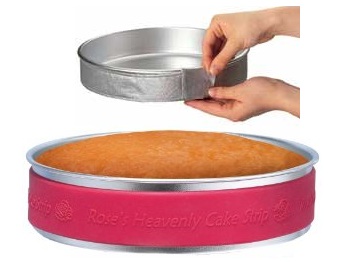
Cake strips are bands of material that wrap around the exterior of a cake pan, providing insulation and keeping cakes from baking unevenly. At least, this is what cake strips intend to do. Cakes usually bake from the outside in, with the edges of the cake baking before the center of the cake because the batter bakes faster when it is in contact with the metal (or glass) of a cake pan. By insulating the sides of a pan, the pan itself heats up less quickly and you end up with a cake that has evenly baked thanks to the heat of the oven and not just the heat of the pan. It is very similar to using a water bath when baking a cheesecake or custard.
A good oven with a reliable oven thermometer and good quality bakeware is often all you need to prevent any baking uneveness, but cake strips say they can help, so Cooks Illustrated set out to test them in their recent (Jan/Feb 2011) issue. They tested Rose’s Heavenly Cake Strip by Rose Levy Beranbaum, Regency Evenbake Cake Strips by Regency Wraps, Magi-Cake Strips by JT Products and Wilton Bake Even Cake Strips, as well as homemade cake strips, with yellow cake and gingerbread recipes. The homemade strips were made by wrapping wet cheesecloth in aluminum foil to form a band and tying it around a pan. The homemade strips worked well, but were somewhat less convenient than using a ready-made strip.
Rose’s Heavenly Cake Strip came out to be the highest rated. This silicone strip slips around both 8- and 9-inch cake pans easily and performed well, keeping cakes even without doming, cracking or creating crusty edges. Regency Evenbake Cake Strips came in as the second choice of the test kitchen, fitting a wide variety of pan sizes and keeping cakes nice and evenly baked. The JT Products strips and the Wilton Strips were not rated as well in the CI test, as they were almost too good at insulating the cakes and produced rounds that were moist and spongy, like steamed cakes, which the test kitchen did not like as much as more tender cakes.

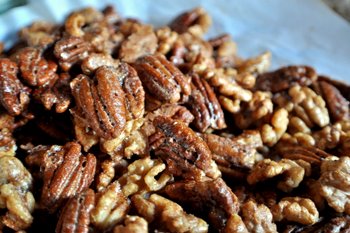
It’s hard to resist freshly made candied or spiced nuts, especially when they’re still just a tiny bit warm from the oven. It’s even more difficult when you have a good combination of sweet and savory spices on those nuts, as it gives them a rather addictive quality. Fortunately for some of my holiday guests, this is exactly the treatment I gave to these pecans. I tossed untoasted pecans with a combination of cinnamon, cloves, allspice and a bit of vanilla extract. Then, I added in a big pinch of cayenne pepper and a generous amount of salt before roasting the nuts in the oven until crispy and fragrant.
These nuts can be prepared in advance and, after they have been completely cooled, can be stored in an airtight container until you’re ready to serve them. They’re a great everyday snack and even better snack food for a party.
You can use different nuts for this recipe, or a combination of nuts, too. It’s easy to play around with this combination of spices for different flavors. For instance, you can increase the cinnamon and add ground chipotle chilies to the mixture for a smokier flavor, or you could add a splash of orage oil to add some citrus notes into the mix. The basic recipe is good, but that is exactly what it is supposed to be: basic enough to encourage you to turn a recipe like this into your own signature snack!
+Continue Reading

Molasses is a byproduct of the process of refining sugar cane into sugar. It is a thick syrup, dark in color, with a very strong sweet and somewhat bitter flavor. It is frequently used in baking and it is particularly popular in recipes for spice cookies and cakes, where it adds a lot of brown sugar flavor without making a recipe too sweet. Like honey, molasses attracts moisture and recipes that use it will tend to stay more moist for longer periods of time. This is an especially great feature for spice cookies and cakes, where the flavors of the spices will develop more over time when a recipe can be prepared a day or two in advance.
When sugar cane is processed into sugar, the sugar cane is pressed to extract all of the sugar-juice from the plants and this syrup is boiled to promote the formation of sugar crystals. There are three types of molasses – light, dark and blackstrap – and the boiled liquid from the first press of sugar cane is light molasses. It is sweeter and less dark in color than the other two. Dark molasses is formed when the boiled sugar cane juice is boiled again. Blackstrap molasses is the result of the third, and final, boiling of the sugar cane juice. It is the thickest, darkest and least sweet molasses. Molasses can be sulphured or unsulphured, as sulphur was often added to molasses as a preservative in the past, as well as to kill unwanted bacteria and to help whiten the resulting sugar crystals, although it is uncommon now.
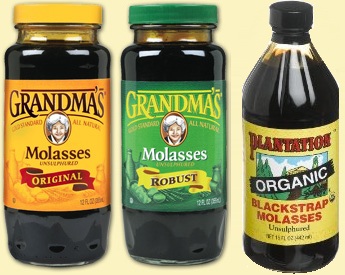
Most molasses used in baking is unsulphured, light molasses – even if the labels don’t specifically say (like the molasses above). Dark molasses and blackstrap molasses are usually labeled as such, or are described as “robust” to emphasize the fact that they have a stronger flavor. The three are interchangeable in baking, although most recipes that call for molasses (unless otherwise specified) assume that you will be using the sweeter, milder light molasses. Feel free to experiment with other molasses varieties in your baking and cooking if you’re looking for a darker flavor. If you’re looking for an even lighter flavor, maple syrup and agave syrup can often be substituted for part of the molasses called for, as well.