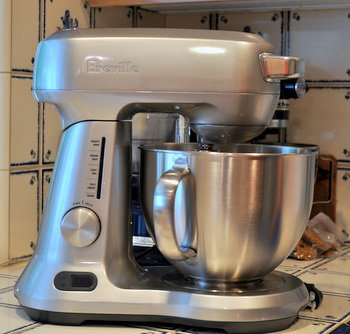
If you’re in the market for a new stand mixer – or a first stand mixer – Breville’s new 5-quart Stand Mixer is definitely worth a look as a solid option that will preform well in any home kitchen. I recently added one to my collection to see how it performed and what features it brought to the table when compared to the Vikings and Kitchen Aid models that I’ve used in the past.
The first thing to like about the Breville is its look. It is modern, with jut a hint of a retro aesthetic to its overall shape, and made of die-cast stainless steel with a brushed finish that will look great in just about any kitchen. Looks aside, it has many other great features. The mixer boasts a 550 watt motor, 12 mixing speeds and a backlit LCD timer that lets you really customize the way that you it, as well as lots of included accessories. The tilting head locks into place when in mixing position and when upright. The cord can be stored inside the base of the mixer so that it doesn’t clutter up the counter.
The mixer head uses a dual rotation motion, meaning that it the mixer head makes a kind of small looping shape while it is working and doesn’t just stay in place. It’s the difference between using a hand mixer and keeping your hand over the very center of your bowl, rather than rotating your mixer over the whole area of your bowl. The 12-speed control gives you tons of flexibility, more than most mixers I’ve used. The slowest setting is so gentle that you’re virtually guaranteed that even very powdery dry ingredients won’t fly over the sides of the bowl, while the faster ones will beat egg whites to stiff peaks in no time flat. Each setting is clearly labeled with a suggestion as to what that setting is most appropriate for – Aerate/Whip, Cream/Beat, Light/Mix and Fold/Knead. This makes it very easy to translate any recipe into something that can be made in the mixer.
+Continue Reading

I’ve only had the opportunity to visit General Mills’ photography studios twice, once last year and once this year, but anyone who regularly shoots food photos would appreciate the amazing setup that they have there. They make all of the food they photograph in kitchens inside the studios, so the food only has to travel a couple of feet from the oven or stove to where it will be photographed for a cookbook or to put on one of the General Mills’ brand websites, like Betty Crocker. The photographers also take the opportunity to get even more creative and there is a gallery showcasing some of their work that shows the more creative side of food photography, using food in unexpected and beautiful ways. I took a couple of stills from that gallery before, and was glad that I could take another couple of pictures this time around. The first one is obvious, but any guesses on what the foods are in these photos?


+Continue Reading

It’s funny what inspires you to bake, sometimes. This Rosemary and Garlic Focaccia was inspired by some really, really mediocre bread that I was served at an Italian restaurant recently. It is completely unlike that bread, and it was the fact that I was wishing for some good focaccia with lots of garlicky olive oil that make me come home and bake my own.
I started out with a plain focaccia dough that had a little bit of olive oil in it, and added in fresh rosemary and sauteed garlic to give it a little more of a savory flavor. Both elements really complement the olive oil’s fruitiness. The finished focaccia isn’t the thick, cut-in-half-to-make-sandwiches focaccia. It is thinner and bakes up to be soft in the center and crisp around the edges. For me, this is the perfect kind of focaccia for dipping into seasoned olive oil when you want a snack before dinnertime.
It doesn’t take too long to make this bread from start to finish, but you will need to allow some time for the bread to rise, so if you want to serve it with dinner it is best to start a couple hours ahead of time. While I used fresh, you can easily substitute dried spices into this recipe and still get a good result. Use about 1 1/2 tsp dried rosemary and 1 tsp garlic powder. I don’t like to overdo it when I’m using dried spices in breads because they can go from subtle to overwhelming pretty quickly. This bread is at its best when it is freshly made, but you can store the leftovers in an airtight container, then pop them in the oven for 5 minutes at 350F to crisp it up again the next day.
+Continue Reading
Icebox pies are a type of pie that requires no baking. Usually, they have a graham cracker or crumb crust that is simply pressed into a pan and chilled, and they are filled with a variety of creamy fillings that set up in the refrigerator or freezer rather than in the oven. As a rule, the pies are easy to make and are a great thing to pull out of the fridge on a hot summer day, even though they are good enough to enjoy all year round. Icebox Pies is a book dedicated to these pies, with over 100 recipes for creamy, cool pies that even bakers with a pie phobia can make without a second thought.
The book starts off with an introduction to icebox pies and an overview of the ingredients and techniques, then follows that up with a whole chapter on the crumb crusts that are the foundation of these pies. There are actually 15 different crusts listed, and most would work well in recipes besides icebox pies, too. The rest of the book is divided up by pie type, including mousse pies, chocolate pies, fruit pies and ice cream pies. While each recipe is different, you can expect to find recipes that use cream cheese, whipped cream and ice cream as primary building blocks for the center of the pie – and you’ll be amazed with the variety of flavors that will come out of the pies in the end.
The beauty of recipes like these is that just about anyone can make them, even kids with a little bit of adult supervision. They’re fun to make and fun to eat, but when you can get everyone involved in making the pies and them decorating them before serving, they’ll be that much more satisfying to eat. That said, don’t think that these are cool-whip pies that only kids will like. There are plenty with sophisticated flavors and textures that would be a hit at any dinner party, too.

Earlier this week, I was invited to Minneapolis to visit the General Mills Headquarters with a group of fabulous other bloggers and participate in an event called Baking with Betty. That refers, of course, to Betty Crocker. Unfortunately, since Betty is really just a figurehead and not a real person, we didn’t actually get to bake with Betty. We did the next best thing and did a lot of baking inside the Betty Crocker Test Kitchen!
You might recall that I visited General Mills last year during a blog event called Eat & Greet, where I toured the test kitchens and visited General Mills’ photography studios. That was also a fantastic event with lots of other great bloggers, but ever since then I have been hoping for a chance to do some baking inside of those test kitchens myself.
+Continue Reading