Archive for January, 2008
I don’t deny that I have a sweet tooth, and after talking about the differences between demerara sugar, muscovado sugar and turbinado sugars, I couldn’t resist mentioning one more interesting type of natural sugar: sugar crystals. Sugar is crystalline in its normal state, but “sugar crystals” is used as a name to describe unusually large crystals of sugar. The crystals are formed just the way that rock sugar candies are, essentially letting small clusters of crystals come together into larger groups. They are made with unrefined sugar and have a brown color from the natural molasses of the cane. They also have a subtle molasses-like flavor to them that sets them apart from straight white sugar. The large crystals dissolve very slowly, even in hot liquids, but are pretty popular as an addition to coffee and tea because of the way they add flavor. They can be used to top off baked goods, as well, and will add a fair amount of crunch to a quick bread or coffee cake. The crystals are too large to be substituted into a recipe for regular sugar, although they could be treated in the same way as an add-in like chocolate chips, and stirred into the batter for texture and flavor.
You can find these crystals in some natural foods stores and occasionally in a well-stocked coffee shop, but you can also order them online. Adagio Teas sells the crystals in several different package sizes if you only want to try a little bit at a time (presumably with tea).
After mentioning the bake-in pie spatula, I began to wonder if there was an equivalent product for cakes, and if there wasn’t, why not. The first slice of a cake is at least as difficult to get out of the pan as the first slice of a pie, especially for homemade cakes, which are often frosted and served straight from the pan. It’s hard to jam a regular, square cake server into the corner of a 9×13 pan for a clean first piece.
I eventually found a Bake-In Cake/Brownie Spatula that is almost identical to the pie server. Unfortunately, it seems to have been discontinued and my search had to head in another direction. Happily, I came across a neat spatula that promises to be able to deliver that first slice of cake cleanly. The Stainless Steel Flexible Spatula is made of very thin, but sturdy, metal that curves under and around a slice of cake. It works best when used against the side of the pan (getting that first corner slice) and especially if you are using a pan with slightly curved edges, such as a pyrex sheet pan. Though it is flexible, it is still sturdy enough to lift out a piece of cake or a slice of brownie without worry that it can’t handle the weight. The spatula works just as well with additional slices, too, of course.
Be still my heart. Williams Sonoma is offering up a pancake mold that does more than just help control the spread of pancake batter. The Fill n’ Stack Pancake mold actually allows you to take breakfast to a whole new level of design by creating a tower of pancakes with a ready-to-fill well in the center that can be a jumping off point for hundreds of breakfast combinations. I’m imagining that the center could be filled with fresh berries, caramelized apples, yogurt and granola, whipped cream or just plain butter and syrup for a start. The filling will be a surprise and, with the tower carefully arranged on the plate, your breakfast guests are definitely going to feel like this is a “gourmet” presentation.
And yes, you can carve up regular old pancakes and do this yourself, but the point of a pancake mold in the first place is to fancy up a very homey breakfast favorite. Even if you’re not normally a fan of pancake molds, it’s likely that you’re going to get a neater, more polished result with the set than without it.
Also, if you haven’t done much shopping recently, it’s worth taking a look at WS’s new website design. It’s much flashier than their old one and the recipe section – which I like quite a lot – has gotten a bit of a facelift.

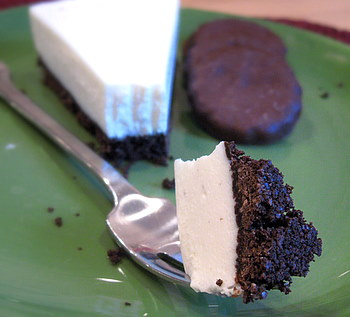
When I started out on my self-appointed task to make homemade versions of some popular Girl Scout cookies, I didn’t have any problem picking out Do-Si-Dos, Samoas and Tagalongs as my top choices. But I thought it might be fun to throw in a recipe that used Girl Scout cookies, too, and this is that recipe. I opted to use the ever-popular Thin Mints – crispy, chocolate dipped mint chocolate wafers – as a crumb crust to compliment a vanilla cheesecake.
Because the cookies are chocolate-covered, the idea of an unbaked crust appealed to me as it guaranteed that I wouldn’t end up with chocolate running all over the floor of my oven. No-bake cheesecakes, however, have never been a favorite of mine because there seem to be so many ways to screw them up. They should be easy to make because you don’t need to worry about over cooking or fussing with a water bath, as you do with some baked cheesecakes, but I’ve had too many that are extremely fluffy (Cool Whip/marshmallow-type consistency) or far too dense (straight cream cheese, perhaps cut with a little lemon zest). This in mind, I decided to see if I could find a nice middle ground that would taste like a nice, creamy cheesecake while still showcasing my mint chocolate crust.
I used a mixture of cream cheese and whipping cream as the base for the cheesecake – the cheese for flavor and texture and the cream for lightness. Held together with a bit of gelatine (or gelatin, if you prefer), the cake turned out beautifully: easy to make and satisfying to eat. It is light and creamy, yet not “airy” at all. It’s quite a bit lighter than most baked cheesecakes, though in this case it really seems to let the mint chocolate flavor of the crust stand out. In fact, the whole dessert reminds me a little bit of mint chocolate chip ice cream, flavor-wise.
Now, if you don’t have a box of Girl Scout Thin Mints or you don’t want to make them yourself, Keebler makes a cookie called Grasshoppers that are identical to Thin Mints. Same texture, same shape, same nutritional stats, same taste – and they’re usually really inexpensive when they’re on sale.

+Continue Reading
Sometimes I suspect that it is more difficult to find a good all-purpose cookbook than any other type of cookbook. There are so many baking books, grilling books, celebrity books and beautifully illustrated, single-subject cookbooks out that they dominte the cooking section of every bookstore. And, of course, I absolutely love these cookbooks, but that being said, I also love having reliable cookbooks that I can turn to for any type recipe. The Good Home Cookbook falls into this category of all-around cookbook.
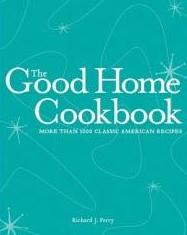
I’ve mentioned this cookbook around this site on occasion, and even mentioned it at Slashfood a while back. It is a no-frills cookbook (by which I mean no pictures) full of classic, American recipes. The really interesting thing about it is that the recipes were tested by the public; the cookbook publishers opened testing to anyone who wanted to participate and sent out recipes, collected feedback and used it to revise the recipes before publishing. I actually was one of the testers when it was being developed (and I know that more that a few other food bloggers were, too), and I can’t deny that I have a soft spot for the book in large part because I had such success with all of my test recipes.
Back to the book, don’t be put off by the fact that there are no photos. The recipes are straightforward and easy to follow. Perhaps it’s knowing how they’re tested, but there is something about this book that always makes me feel comfortable flipping to a random page – whether the recipe is for steak, an omelette, bread or cookies – and feeling confident that I’m going to be pretty happy with my results.